 Shuffling Toward Sanctions, Mumbling Uranium
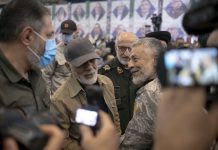
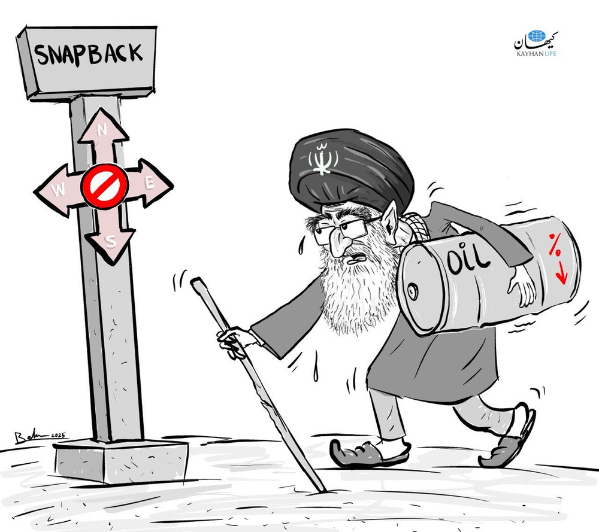
The so-called supreme leader of the Islamic Republic, Ali Khamenei, emerged Tuesday night for another televised monologue. Frail, isolated, and visibly clinging to the scraps of his authority, Khamenei once again railed against the world, declaring that nuclear enrichment will never stop, that negotiations with the United States are forbidden, and that “the nation will slap in the mouth anyone who suggests otherwise.”
As the UN General Assembly opened in New York—a rare chance for his president Masoud Pezeshkian and one of his chief envoys Abbas Araghchi to test the waters with Western officials—Khamenei’s speech dropped like a lead weight. Instead of signaling flexibility, the clerical figurehead doubled down on rejectionism, ordering his ineffective government to close ranks and repeat the same lines the theocratic state has been shouting for decades.
The bunker sermon was heavy on angst. America, he said, wants not just an end to enrichment but also a ban on missiles, leaving the Iranian regime defenseless.
Dialogue with Washington, he insisted, is “dictation, not negotiation.” Any official who thinks otherwise, he warned, is betraying the “nation,” even as real Iranian people endure economic collapse, mass emigration, and the daily grind of repression.
Khamenei’s disdain for compromise came wrapped in a familiar conspiracy script: the U.S. always lies, cheats, kills—pointing once more to the assassination of Qassem Soleimani as proof that “trust” is impossible. The frail cleric is now more ghost than leader.
For the Islamic Republic, this performance underscored a system that has long since stopped functioning as a state and now survives only as a closed clerical-military shop.
For the Iranian people- grappling with inflation, repression, and the crumbling of basic services- it was yet another reminder that the theocratic state speaks only for itself.
Welcome to the Kayhan Life Week in Review
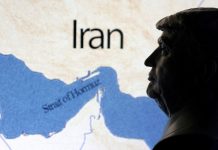
As the clock ticked toward a Saturday deadline for the reimposition of international sanctions, the Islamic Republic faced mounting pressure from abroad and growing discontent at home. The week brought renewed diplomacy, sharper rhetoric, and reminders of the theocratic state’s fragility.
At the United Nations Security Council, the drama unfolded with a familiar predictability. Russia and China attempted to shield their ally by proposing a resolution to postpone the “snapback” of sanctions suspended under the 2015 nuclear deal. Only Algeria and Pakistan joined them. Eleven other members—including the United States, France, Britain, South Korea, and even Panama and Somalia—voted no.
The defeat means sanctions—frozen for nearly a decade—are set to roar back to life Sunday morning, further straining an already fragile economy. Foreign Minister Abbas Araghchi, called the move “legally void” and “politically reckless.” “The United States has betrayed diplomacy, but E3 has buried it,” he thundered, only for France’s permanent representative of the UN in New York, Jerome Bonnafont to dismiss the charge and note that the theocratic state had taken no serious steps to avoid this outcome.
President Masoud Pezeshkian, speaking in New York, tried to present a calm resolve. “Iran has never sought and will never seek to build a nuclear bomb,” he told the General Assembly, while refusing to halt uranium enrichment. He promised that the Islamic Republic would remain within the Non-Proliferation Treaty.
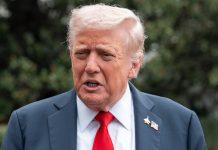
Washington’s message was gentler but pointed. Donald Trump’s Middle East envoy Steve Witkoff said the United States had “no desire to hurt” the Iranian people. Accordingly the administration barred Islamic Republic delegates from indulging in New York shopping sprees. “We will not allow the Iranian regime to let its clerical elites indulge in luxury while the Iranian people endure poverty, crumbling infrastructure, and dire shortages of water and electricity,” the State Department said.
Meanwhile, the regime sought to display alternatives. Agreements with Moscow—including plans to build eight nuclear power plants—were announced as both defiance and dependence. Satellite imagery analyzed by the Associated Press suggested the Islamic Republic was already rebuilding missile-production facilities damaged during its 12-day war with Israel in June, though analysts noted that crucial components for solid-fuel production were still missing.
At home, the troubles ran deeper than sanctions. Nearly a third of the Iranian people live in poverty; inflation has shredded household budgets; and rolling blackouts have become part of daily life.
Repression intensified: human rights groups reported a surge in arrests targeting religious minorities, particularly Bahá’ís. The death of political prisoner Somayeh Rashidi, denied timely medical care, echoed long-standing accusations that the regime deliberately withholds treatment. And once again, hostage diplomacy reappeared, with a British couple—Lindsay and Craig Foreman—facing espionage charges after being detained while motorcycling across the country.
Amid the week’s latest developments , a book offered a different kind of reminder. Unveiled: Inside Iran’s #WomanLifeFreedom Revolt, by British-Iranian journalist Jonathan Harounoff, revisits the protests ignited by the 2022 death of Mahsa Amini. It traces how her death became a rallying cry for the Iranian people demanding dignity, equality, and accountability—demands the clerical leadership has not managed to silence, despite prisons, propaganda, and the truncheon.
The paradox of the Islamic Republic remains intact. Abroad, the regime projects toughness through nuclear brinkmanship, alliances with Moscow, and combative speeches at the U.N. At home, theocratic leaders tighten repression to contain rising anger over poverty, power shortages, and the treatment of prisoners and minorities.
The United States and its allies continue to search for the elusive middle ground between pressure and diplomacy.
For the Iranian people, meanwhile, the struggles remain painfully ordinary.
TOP STORIES
- UN Sanctions on Iran Loom After Vote to Delay Fails
- Iran, U.S. Signal Possible Easing in Nuclear Tensions
- IAEA Chief Says Inspectors on Way to Iran in Case Snapback Deal Struck
- Iran’s President Says It Can Overcome Any Return of Sanctions
- Iran’s Nuclear Chief in Moscow to Sign Power Plants Deal as UN Ponders Sanctions
- US to Iranian Officials Attending UN: No Shopping Sprees in New York
- Iranian Bahá’ís Are Being Targeted After Israel Attack, UK Official Says
- Female Prisoner Dies in Iran; Rights Groups Blame Delayed Medical Treatment
- Inside the ‘Woman Life Freedom’ Revolt: Journalist Harounoff Releases Book on Iran
Kayhan Life’s Curated News
Updates from Kayhan Life’s Social Media
Treat of the Week
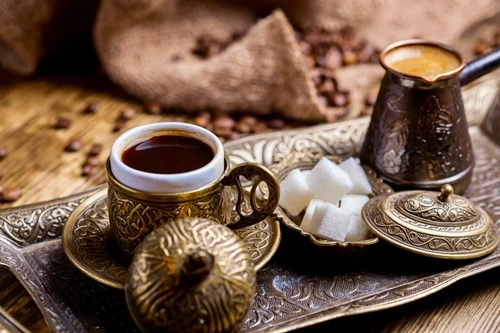
Turkish Coffee: An Ancient Brew with Timeless Charm