By Kayhan Life Staff
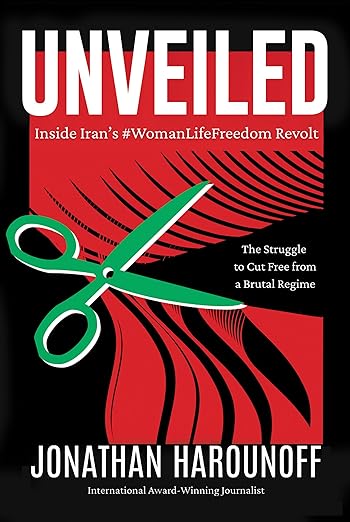
Jonathan Harounoff – a British-Iranian analyst and journalist who currently serves as Israel’s international spokesperson to the United Nations – has just released his first book: “Unveiled: Inside Iran’s #WomanLifeFreedom Revolt.”

The book is a detailed account of the historic 2022 protests in Iran, triggered by the death in police custody of Mahsa Amini (for allegedly inappropriate wearing of the compulsory veil). It covers the events that took place before, during and after the protests, and analyzes the potential consequences for Iran.
Harounoff – a graduate of Cambridge University and Columbia who studied journalism, Arabic and Persian — previously held senior communications positions at the Jewish Institute for National Security of America in Washington, D.C., and at XPO, a Fortune 500 company.
Harounoff has written extensively about Iran, Israel and the broader Middle East for such publications as The New York Post, The New York Times, The Los Angeles Times, Newsweek, Haaretz, The Jerusalem Post, The Jewish Chronicle and The Forward.
“Iran – the country, history, culture, and politics – has always been a part of my life,” he writes in the preface to the book, explaining that his grandparents on both sides came from the Jewish community of Mashhad, known as the “holiest city in Iran” for its pilgrimage shrine of Imam Reza – the burial place of the eighth Imam in Twelver Shi’ism.
“I grew up listening to Persian, surrounded by Persian carpets, music and food,” he writes. “My favorites include staples like ‘tahdig,’ crispy rice infused with saffron; ‘ghormeh Sabzi,’ a Persian stew consisting of meat, green herbs, beans and dried limes; as well as meatballs made out of lamb or chicken known as ‘gondi’.”
Despite what he calls traumatic, painful elements in Iran’s Jewish history, Harounoff writes that Jewish Iranians still feel a huge sense of pride and attachment to Iran, and dissociate the country and its thousands of years of rich history and civilization from the 46-year-old Islamic Republic.
“Like many in the diaspora, my family saw the authoritarian regime as not so much leading but occupying Iran for nearly five decades,” he writes.
Since the 1979 Islamic Revolution, the population of Persian Jews has dwindled from 80,000 to around 10,000 today. Yet remarkably, according to Harounoff, Iran still has the second-largest Jewish population in the Middle East after Israel.
In a recent interview with Kayhan Life, Harounoff spoke about his life and book.
Your grandparents were members of the Jewish community in Mashhad, yet you grew up in Britain and have never been to Iran. What made you decide to write a book about it?
I grew up surrounded by Persian and Hebrew being spoken by my grandparents and great-grandparents, by Iranian art and Israeli music, and of course delicious cuisine from both places. Despite Iran and Israel having always been in a state of enmity in my lifetime, it always seemed as if there was so much commonality and affinity between these two civilizations, and it was always a source of fascination to me.
When you read the news about Iran or the Islamic Republic, you almost always see bulletins about the Islamic Republic’s dangerous nuclear weapons program or its proxy forces, but rarely do you see news in the mainstream media about the people of Iran: who they are, what their aspirations are and whether or not the 90 million-plus people there share similar views to that of the regime.
In the course of researching and interviewing for the book, I wanted to write a book that illuminated just how vast that gulf is between the predominantly peace-seeking, resilient and courageous people of Iran and the brutal regime that has been crushing its own people’s freedoms and socio-economic mobility for the past 46 years.
How were the Woman, Life, Freedom movement and the death of Mahsa Amini triggers for you to embark on the writing of this book?
I had been covering Iran and Israel as a journalist for a variety of publications at the time of the killing of Mahsa Amini in September 2022.
As I started writing more about the uprising, I decided to collate all of this research and the moving testimonies I captured into a book, especially since barely anything had been written about the Mahsa Amini uprising in book form because of how recent it was.
The book was three years in the making and incorporates powerful voices of Iranians from inside Iran and the diaspora who had suffered directly from the Islamic Republic in various walks of life — from young female executives navigating the tricky corporate world for women, to athletes, actors, politicians and musicians.
At the same time, I also wanted to cover the movement from a more pragmatic perspective and investigate why the movement ultimately fell short of its objective of toppling the regime — in part as a result of the regime’s unrelenting campaign of mass arrests, executions and disappearances, because international support wasn’t sufficiently followed by tangible action against the regime in a sustained fashion, and because the opposition abroad didn’t remain unified and only remained united largely in what it despised, namely the regime, but not united in what kind of plan it envisioned for a post-regime Iran.
The book went to press before Israel’s attacks on Iran. How damaging have those attacks been to the regime in Tehran? Could a next attack push the regime over the brink?
The book’s publication coincides with the three-year anniversary of Mahsa Amini’s death and the start of the “Woman, Life, Freedom” revolt that ensued.
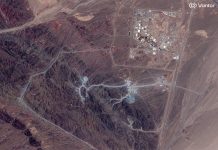
The Israeli and American precision strikes on nuclear facilities inside Iran and key regime facilities and locations proved devastating and significantly weakened the regime.
I think possibly most devastating to the regime is the confluence of severe domestic challenges that remain unresolved, especially the catastrophic water crisis and gas and electricity shortages enveloping almost all of Iran’s 31 provinces. These internal challenges, combined with the regime’s weakened military, put it in a vulnerable position. But so long as the people inside Iran continue to suffer and their government does nothing to alleviate that suffering – and instead is hellbent on sowing destruction abroad and diverting resources abroad – there will be unrest among the people of Iran.
You write in several places that the country is potentially on the verge of another revolution that could sweep away the Islamic Republic the same way that the 1979 movement swept away the Shah — and that what comes next remains elusive. Can you elaborate?
The Islamic Republic’s history has so far been short but filled with bouts of internal turmoil and external pressure.
We’ve seen in 2009 and 2022 that all it takes is one spark, like the killing of Neda Agha Soltan or Mahsa Amini, to trigger enormous, nationwide unrest – and unfortunately the regime’s brutality shows little sign of abating, but the resolve of the people of Iran also remain ironclad and another clash is likely to erupt in the not-too-distant future.