| Waging a Two-Front Campaign: Hard Power Against the Islamic Republic, Soft Power Against Global Inflation
By Behnam Mohammadi
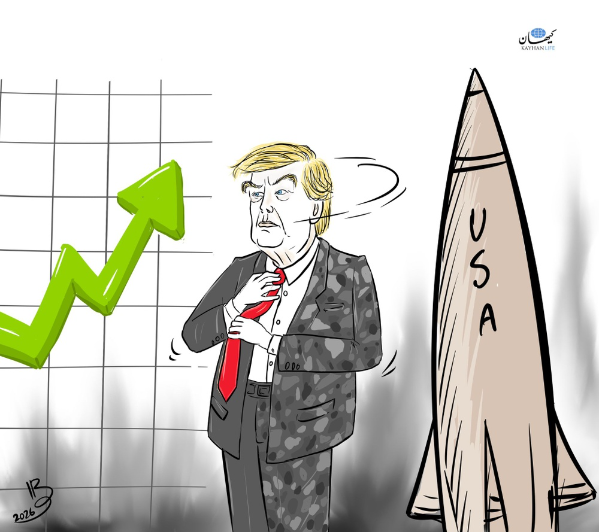
As the U.S.-Israeli war against the Islamic Republic disrupts energy flows through the Strait of Hormuz, President Donald Trump seeks to overpower Tehran without further unsettling global markets.
Welcome to the Kayhan Life Week in Review
This week, as Iranians marked Nowruz amid war, executions, repression, and economic distress, the theocratic state raised the stakes abroad. From punishing protesters and public figures to louder hardline calls for a nuclear bomb, missile attacks on Israel, pressure in the Strait of Hormuz, and the spread of conflict into Iraq and beyond, the Iranian regime pursued a strategy of escalation to make confrontation more costly for Washington and its allies.
►Tens of millions of Iranians living inside and outside the country celebrated the Persian New Year (Nowruz) in the somber context of a U.S.-Israeli military campaign against the Islamic Republic, and in the aftermath of a deadly crackdown on protesters.
Iranians Celebrate Nowruz Amid Bombings; Mourn Victims of Crackdown
►Meanwhile, the Islamic Republic escalated executions and prison terms for those arrested over the January protests. The execution of 19-year-old champion wrestler Saleh Mohammadi deepened the grief felt by Iranians. Former water polo player Reza Soleimani spoke after the execution about the pain many Iranians feel over the state’s treatment of young protesters.
Former Iranian Water Polo Player Soleimani Distraught Over Wrestler’s Execution
Iran Says It Is Implementing Sentences Against Convicted January Protesters
►Star striker Sardar Azmoun was left out of Iran’s national team after he was expelled for “disloyalty” to the regime.
Azmoun Left Out of Iran Squad After Expulsion Reports
►Revolutionary Guards commander Mohammad Bagher Zolghadr replaced slain security chief Ali Larijani, signaling continuity through militarization and repression rather than a turn toward pragmatism.
Iran Names Hardline Ex-Revolutionary Guards Commander to Replace Slain Security Chief
►Debate and division inside the leadership became louder and more open over whether to pursue a nuclear bomb.
Iran Hardliners Ramp up Calls for a Nuclear Bomb, Sources Say
►Dismissing President Trump’s claims of productive talks and saying Washington was “negotiating with itself,” the Islamic Republic launched waves of missiles at Israel, presenting itself as actively engaged in war and contemptuous of diplomacy.
Iran Sends Waves of Missiles Into Israel, Dismisses Trump’s Talk of Negotiations as ‘Fake News’
Iran’s Military Rejects Trump’s Talk of Negotiation, as Israel and Iran Launch Airstrikes
►Washington, in return, responded with an ultimatum, underscoring that the conflict is as much about the battlefield as a test of political submission.
Trump to Hit Iran Harder if Tehran Does Not Accept Defeat, White House Says
►The Strait of Hormuz became a central front for the regime’s leverage over the vital shipping route. The Islamic Republic said “non-hostile” ships could pass if they coordinated with Iranian authorities. Trump cast tanker transit as a present for back-channel bargaining, saying Tehran had allowed 10 oil tankers through the Strait of Hormuz.
Iran Says ‘Non-Hostile’ Ships Can Transit Strait of Hormuz, FT Reports
Trump Says Iran’s ‘Present’ to US Was Allowing 10 Oil Tankers Through Hormuz
►The war also spread into Iraqi territory through the Islamic Republic’s militia network. Airstrikes targeted the headquarters and leadership of an Iraq-based umbrella group for Iran-backed Shi’ite militias, killing fighters. In response, Iraq’s National Security Council authorized the Popular Mobilisation Forces to respond to attacks on their positions.
Airstrikes Target HQ and Leader of Iran-Backed Shi’ite Militia Umbrella Group in Iraq
Iraq Allows Iran-Backed Shi’ite Militia Umbrella Group to Respond to Attacks on Their Positions
►The conflict spilled into commercial infrastructure and digital systems in the Persian Gulf. Amazon said drone activity disrupted its AWS region in Bahrain.
EXCLUSIVE – Amazon Says AWS’ Bahrain Region ‘Disrupted’ Following Drone Activity
►As the threat to global shipping and energy supplies widened, the international community moved from statements of support to active planning to protect—and eventually reopen—the Strait of Hormuz. Bahrain proposed a U.N. Security Council resolution authorizing the use of force to protect shipping. At the same time, European nations, Japan, and Canada said they were ready to help secure passage and stabilize energy markets. Meanwhile, France held talks with around 35 countries to reopen the Strait of Hormuz once the war ends.
Bahrain Proposes UN Security Council Approve Use of Force to Protect Hormuz Shipping
Joint Statement on Strait of Hormuz by European Nations, Japan, Canada
France Says It Approached 35 Countries Over Future Hormuz Mission
►The U.S. military, meanwhile, prepared for a longer fight, even as Washington continued to talk publicly about the possibility of a deal. Reports said thousands more American troops could be sent to the Middle East, adding to a major buildup.
US Expected to Send Thousands More Soldiers to Middle East, Sources Say
►A major exclusive offered new information on the opening phase of the war. Reuters reported that Trump approved the operation after Netanyahu argued for a joint strike to kill Ali Khamenei. A further Reuters report showed how deeply regional and international actors are now involved in managing the conflict’s risks. According to a Pakistani source, Israel removed Iranian Foreign Minister Abbas Araqchi and Parliamentary Speaker Mohammad Baqer Qalibaf from its hit list after Pakistan urged Washington to press Israel not to target them.
EXCLUSIVE – Trump Approved Iran Operation After Netanyahu Argued for Joint Killing of Khamenei
Israel Took Iran’s Araqchi, Qalibaf off Hit List After Pakistan Request to US, Pakistani Source Says
►The Iranian regime’s reach was also visible far from the battlefield. A British lawmaker said Tehran used U.K. charity law to build influence networks, arguing that theocratic-state soft power has expanded through regulatory weaknesses in Britain.
Tehran Uses UK Charity Law to Exercise Influence, Says UK Lawmaker
►The family of two imprisoned Britons said they were being used as “human shields” in the war zone, a charge that highlighted the Iranian regime’s use of “hostage diplomacy.”
Detained Britons Used as ‘Human Shields’ in Iran War Zone, Family Says
|