|
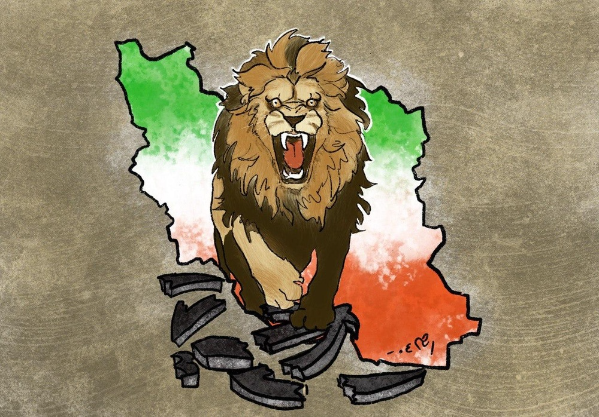
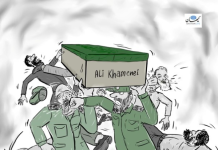
Artist: Ahmad Barakizadeh
The Lion Has Risen
Millions of Iranians poured into the streets in all of Iran’s 31 provinces on Jan 8 and 9 after a call by Prince Reza Pahlavi, the exiled son of Iran’s last monarch. Chants of “Javid Shah” and “This is the last battle, Pahlavi will return” reverberated not only through city squares and neighborhoods but across global airwaves, amplified by the Iranian diaspora and social media networks abroad.
What unfolded was a national decision by Iranians following years of civic protests that had borne no result. The spirit driving the demonstrations echoed the roaring lion whose patience after years of constraint had finally yielded to resolve.
Disparate grievances and localized protests have converged into a national assertion of will. This national surge has irreversibly reshaped Iran’s political and social terrain.
Whether the Islamic Republic manages to endure a while longer matters less than the shift that has already occurred. History is turning a page, and this time the people of Iran are its principal authors.
Welcome to the Kayhan Life Week in Review
Iran has entered one of the most consequential moments in its modern history. As nationwide protests intensify, the Islamic Republic faces mounting internal dissent, international condemnation, and a growing crisis of legitimacy. From unprecedented calls to action by opposition figures to sweeping internet blackouts, deadly crackdowns, and global diplomatic responses, this edition brings together the key developments shaping Iran’s rapidly evolving unrest—alongside reflection, remembrance, and unfinished national tragedies that continue to define the country’s past and present.
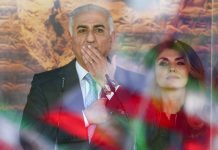
►For the first time since the 1979 revolution, Prince Reza Pahlavi issued a call to protesters. His message signaled a pivotal shift from symbolic leadership to political engagement at a moment many see as historic.
►Reacting to Pahlavi’s call and protests spreading nationwide, the Islamic Republic’s Supreme Leader accused protesters of acting on behalf of Donald Trump and vowed that they would be severely punished, as the state switched off the internet.
►With unrest evolving rapidly and foreign pressure mounting, the clerical establishment appeared unable to tackle what has become a crisis of legitimacy at the heart of the Islamic Republic.
►Iran‘s top judge warned protesters there would be “no leniency for those who help the enemy against the Islamic Republic, while accusing Israel and the U.S. of pursuing hybrid methods to disrupt the country.
►Rejecting external pressure and protesters’ demands, Ali Khamenei vowed that the state would not yield. Rights groups reported a surge in arrests as security forces intensified their response.
►Iran‘s efforts to quell a wave of anti-government protests were complicated by Donald Trump’s threat to intervene on their side, a warning firmly underlined by the subsequent U.S. capture of Venezuela’s Nicolas Maduro, officials and insiders said on Monday.
►At least 25 people were killed in Iran during the first nine days of protests that started in the bazaar of Tehran over the plunging value of the currency and soaring inflation, according to rights groups.
►In a powerful commentary, Kayhan London editor-in-chief Elahe Boghrat argued that Iran has reached a decisive crossroads. She examined why many now view the Shah’s leadership not as symbolic but as a historical necessity.
►As violence intensified, international voices began to weigh in more forcefully. A French diplomatic source called on the authorities of the clerical state to exercise maximum restraint toward protesters, who have a legitimate right to demonstrate.
►That call was echoed at the European level. European Union foreign policy chief Kaja Kallas condemned the response of the Iranian security forces to protests as “disproportionate” and added that any violence against peaceful demonstrators is unacceptable.
►Soon after, European governments moved in unison. In a rare joint statement, European leaders, including France’s Emmanuel Macron, denounced the killing of protesters. The coordinated response underscores growing global alarm over Iran’s crackdown.
►European Parliament President Roberta Metsola also expressed solidarity with Iranian demonstrators.
►On the cultural front, more than two decades after disaster struck Bam, recovery remains painfully incomplete. This report reveals how neglect, stalled reconstruction, and broken promises continue to haunt a UNESCO-listed city.
►Finally, we remember a figure from Iran’s pre-revolutionary era. A look back at the life and legacy of Hushang Ansary, a key figure in Iran’s pre-revolutionary economic development. His passing marks the end of an era shaped by ambition, modernization, and global engagement.
|