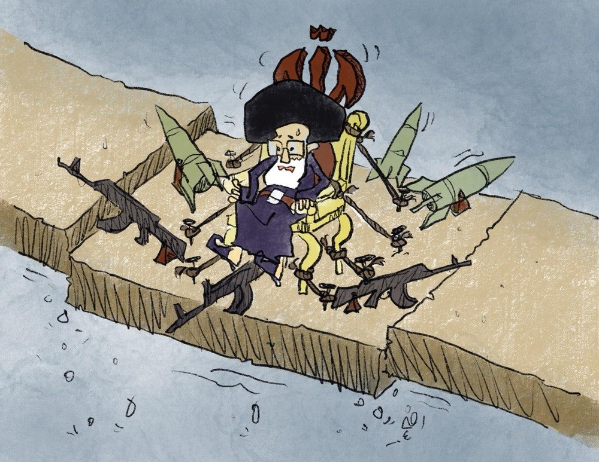
Artist: Ahmad Barakizadeh
The Islamic Republic’s Greatest Enemy: Itself
The Islamic Republic of Iran has once again demonstrated that its most formidable enemy is not America, Israel, or any foreign conspiracy — but its own spectacular incompetence. In a streak of political self-sabotage, Tehran has managed to turn even its proxies against itself. What began as a quest for “strategic depth” has instead become a deep hole from which the regime keeps digging.
After decades of pouring billions into foreign militias to showcase “strategic depth,” the Iranian regime now finds itself watching from the sidelines as others redraw the region’s map because of its intransigence. The Gaza Peace Summit — hosted by global leaders and even former adversaries — proceeded smoothly with an empty seat representing the Islamic Republic. Its allies are busy making deals; its enemies are making progress; and Khamenei’s only contribution is another fiery speech about resistance.
At home, the economy limps through chronic inflation, evaporating oil revenues, and a population exhausted by promises. At the same time, his President Pezeshkian presides over an empty treasury and a full crisis calendar.
Meanwhile, the regime’s strategy for survival remains as visionary as ever: censor harder, hang faster, and pray for miracles. For all its bluster about external plots, the Islamic Republic’s undoing has always been internal. It misreads the world, mismanages Iran’s resources, and clamps down on Iranians. And now, the theocratic state finds itself cornered — not by its enemies, but by its own foolishness.
Welcome to the Kayhan Life Week in Review
►This week’s headlines were dominated by a long-awaited ceasefire in Gaza, a renewed diplomatic push on Iran’s nuclear program, and an escalating crackdown by the Islamic Republic on dissent at home. U.S. President Donald Trump celebrated “the end of the war in Gaza,” Tehran faced new accusations of espionage from Britain, sweeping U.S. sanctions targeting its oil exports, and mounting unrest inside Iran’s prisons amid a surge in executions.
A fragile peace took hold on Monday after Israel and Hamas agreed to a U.S.-brokered ceasefire. Trump hailed the deal as “a dawn of peace in the Holy Land,” announcing the release of all remaining Israeli hostages in exchange for thousands of Palestinian prisoners; however, Hamas’s refusal to disarm has cast doubt on Trump’s proposed 20-point roadmap to lasting peace.
►To ensure the ceasefire’s stability, British Prime Minister Keir Starmer said the country is ready to help monitor the ceasefire in Gaza and to decommission the weaponry and capability of Hamas in the enclave.
►Tehran’s nuclear ambitions remained a high priority for Trump. In his speech to Israel’s parliament, he said Tehran is too focused on survival to rebuild its nuclear capabilities after US attacks in June. He signaled renewed interest in nuclear talks with Tehran, urging a “reasonable and balanced” deal.
►Even within the Islamic Republic, there is increasing acknowledgment of the costs of regional confrontation, conceding that Hamas’s October 2023 attack on Israel had been “a mistake” that badly damaged Tehran’s position at home and abroad.
►While projecting defiance abroad, the Islamic Republic turned inward with increasing brutality. Rights groups reported a surge in executions and arrests under a newly approved “anti-espionage” law. Legal experts warned that the vaguely defined legislation gives authorities sweeping powers to detain citizens for social media activity deemed subversive. Reports emerged this week of Iranians charged with national security offenses simply for “liking” posts critical of the regime.
►Its tightening grip also extended to women’s rights and the mandatory hijab, via new tactics. The Center for Human Rights in Iran said enforcement has become more covert, relying on surveillance, undercover policing, and business closures targeting those who serve unveiled women, particularly outside Tehran.
►Tensions reached a boiling point inside Ghezel Hesar Prison near Tehran. Hundreds of inmates launched a hunger strike following the execution of at least five prisoners on Wednesday. The protest erupted after 16 inmates were transferred to solitary confinement for imminent execution. Families of death-row prisoners rallied outside the facility despite threats from security forces.
-
In Protest Against Executions: Report on the Fourth Day of Prisoners’ Strike in Ghezel Hesar (Curated News)
►The Abdorrahman Boroumand Center reported at least 1,172 executions in Iran so far this year. Its executive director, Roya Boroumand, condemned the surge as “the desperate violence of a state that has lost the consent of its people.” She said, “What is going on behind the closed doors of Iran’s prisons, summary, and arbitrary executions, whose details are deliberately hidden from the public, is nothing short of mass killings.”
-
Forgotten Behind Closed Doors: Iran Must be Held to Account for the Mass Execution of Alleged Drug Offenders (Curated News)
►Abroad, the Islamic Republic faced renewed scrutiny over its covert activities. Britain’s MI5 accused Tehran, alongside China and Russia, of running spy networks targeting British lawmakers and government institutions.
►MI5 Director General Ken McCallum revealed that his agency had disrupted more than 20 “potentially deadly” Iranian plots and warned MPs to be alert to “unusual social interactions” and “overt flattery” by suspected agents.
►Across the Atlantic, in the U.S., Trump expanded his “maximum pressure” campaign by sanctioning a Chinese port accused of handling Iranian oil shipments. China, the Islamic Republic’s largest oil customer, dismissed the sanctions and vowed to continue trade.
►Further straining Tehran’s relations with the West, French nationals Cécile Kohler and Jacques Paris were convicted of spying for France and Israel and of conspiring against national security, receiving combined sentences of up to 20 years in prison. France condemned the verdicts as politically motivated, calling them part of the regime’s ongoing pattern of hostage diplomacy.
►The latest victim of that strategy, British traveller Lindsay Foreman, who has been detained in Iran alongside her husband Craig, was transferred from Qarchak to Evin Prison following a series of inmate deaths and hunger strikes. Her family describes the espionage charges as politically motivated and has urged the UK and US governments to act swiftly to secure the couple’s release.
-
Son of British detainee in Iran hopes for Trump help (Curated News)
Updates from Kayhan Life’s Social Media
Treat of the Week
FONDANT POTATOES