|
 Can The Ayatollah’s Nuclear Sprint Be Stopped? Can The Ayatollah’s Nuclear Sprint Be Stopped?
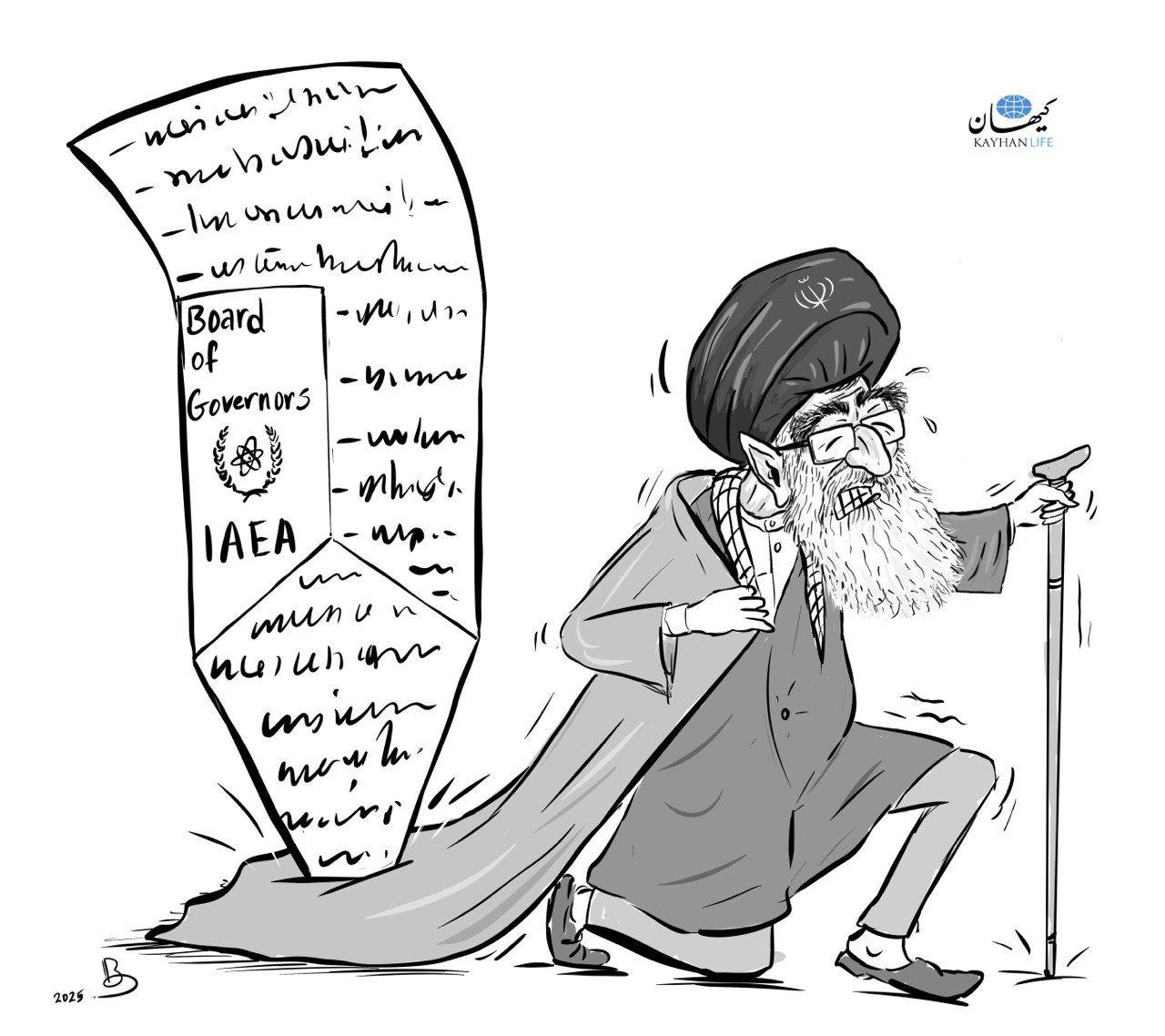
Will the latest resolution by the U.N. nuclear watchdog’s 35-nation Board of Governors be enough to halt the Islamic Republic’s sprint towards a nuclear weapon? The vote delivered a reminder that the rules still exist, challenging the theocratic state’s pretense that such obligations were merely optional décor.
The resolution reiterates that the theocratic state’s right to peaceful nuclear energy under the Treaty on the Non-Proliferation of Nuclear Weapons or NPT exists only if it fulfills its responsibilities—granting full inspector access, restoring monitoring tools, and providing accurate nuclear material accounting.
The theocratic state has failed to meet any of its NPT responsibilities. The cooperation agreement, it signed in Cairo last September, turned out to be nothing more than diplomatic decor. It continued to block inspectors from its most sensitive facilities, including a newly identified clandestine enrichment site. Meanwhile, its nuclear scientists reportedly traveled to Russia seeking advanced technologies with potential weapons applications.
More worryingly, independent experts warn that the theocratic state no longer needs to rebuild the nuclear infrastructure damaged in the June 2025 Israeli-American strikes. It already possesses roughly 400 kilograms of uranium enriched to 60 percent—material that, if further refined, could fuel up to ten nuclear weapons. Much of this stockpile is hidden beneath rubble, like treasure buried by a magician who hopes the audience will forget where it is hidden.
The UN Security Council’s reimposed resolutions add another weight: legal, symbolic, and deeply inconvenient for a state insisting the world has no right to ask questions.
This is the Islamic Republic’s nuclear sprint: a dash under the shadow of its own obligations, chased by paperwork it pretends not to see, and not burdened by the prospect of a final U.N. resolution that becomes more real, the more it is ignored.
Welcome to the Kayhan Life Week in Review
► On the sixth anniversary of the wave of nationwide demonstrations in Iran in November 2019, also known as “Bloody Aban,” the Islamic Republic bowed under the weight of several crises: from inflation and catastrophic flooding to intensifying factional infighting and defections, while facing mounting pressure to meet its commitments under the Treaty on the Non-Proliferation of Nuclear Weapons (NPT).
At home, the Iranian regime is grappling with a severe fiscal crunch. Economists warn that the 2026 budget deficit could reach $90 billion, despite President Masoud Pezeshkian’s assurances that his government has a viable financial plan. The combination of new international sanctions, spiraling costs from the Iran–Israel conflict, and falling revenues has pushed analysts to argue that any meaningful austerity must begin with the vast budgets allocated to religious, ideological institutions and regional proxy networks — expenditures that have swelled by as much as 9,616 percent in the past six years.
►These macroeconomic pressures are having a tangible impact on Iranian society. Fresh data show rising poverty and malnutrition as inflation continues to drive up the prices of staple foods, including meat, rice, bread, and vegetables. Many households are substituting meat for cheaper, less nutritious alternatives, raising long-term public health concerns for future generations. Supermarket theft has also increased, with meat and dairy products most affected.
►Rainfall caused floods in parts of western Iran, after months of drought led to the worst water crisis in decades, pushing authorities to begin cloud seeding. Decades of government mismanagement, rampant illegal well-drilling, and inefficient agricultural practices have all played significant roles in the unfolding emergency.
►Against this backdrop, public dissatisfaction has reached a breaking point. In a recent survey, 92 percent of respondents said they were unhappy with conditions in Iran, expressing little confidence in local lawmakers and frustration that their grievances remain unaddressed.
►Pressure from the clerical state was not confined to Iran. The regime’s security services have increased the harassment of Iranians abroad, including threats to inform on fellow exiles. German intelligence agencies report ongoing espionage efforts, with the Federal Office for the Protection of the Constitution (BfV) noting a high risk and launching a hotline in 2024 to report on terrorism and espionage.
►Meanwhile, Tehran confirmed that its Revolutionary Guards (IRGC) seized the Talara, a Marshall Islands-flagged tanker, in open Persian Gulf waters last week, over alleged cargo violations. This marked Tehran’s first tanker seizure since the Israeli-U.S. strikes in June.
►The international arena delivered yet another setback for the theocratic state. On Thursday, the U.N. nuclear watchdog’s 35-nation Board of Governors passed a resolution demanding that the Iranian regime “without delay” clarify the status of its enriched-uranium stockpile and the condition of bombed nuclear sites.
►Tehran immediately announced that it had formally notified the IAEA of its termination of a cooperation agreement signed in Cairo earlier this year.
►This development cast uncertainty over the diplomatic efforts surrounding Iran’s nuclear program. Those talks had appeared poised for revival after U.S. President Donald Trump suggested that Iran had shown a new willingness to negotiate. Reports of Iran’s interest in renewed dialogue were not confined to Washington. A source cited by Reuters said Tehran had asked Saudi Arabia to help persuade the United States to return to negotiations—an appeal driven by fears of further Israeli military strikes and mounting anxiety over Iran’s deepening economic crisis.
►Amid the escalating tensions, Britain, France, and Germany also reiterated their desire to revive the nuclear talks and said they hoped they could meet with Iran before the end of the year.
|