Under intense U.S. sanctions and facing the looming reimposition of international penalties through the “snapback” mechanism triggered by France, Germany, and the UK (E3), the Islamic Republic of Iran has once again turned to China and Russia in a bid to avoid global isolation.
The snapback mechanism — part of the 2015 Joint Comprehensive Plan of Action (JCPOA), the Iran nuclear deal, and enshrined in United Nations Security Council Resolution 2231 — allows for the swift restoration of international sanctions if Iran is found to be violating its nuclear commitments.
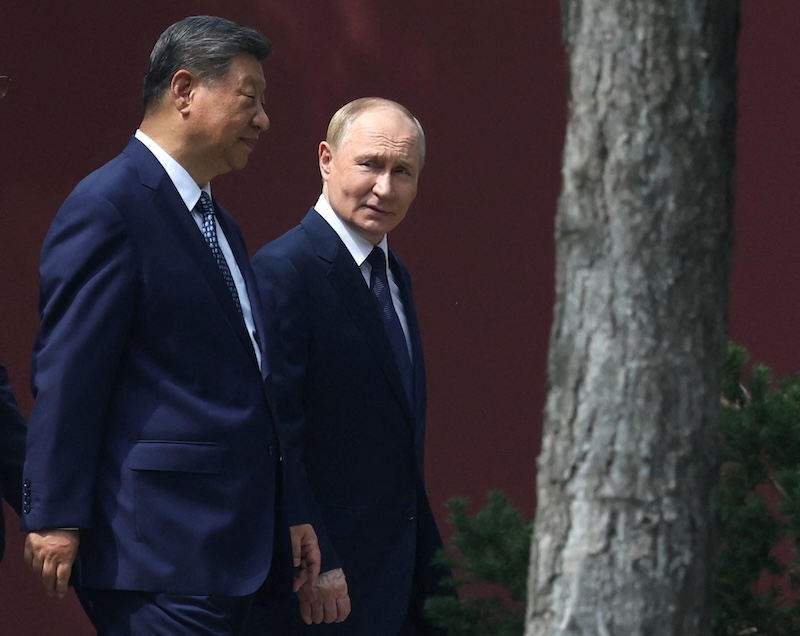
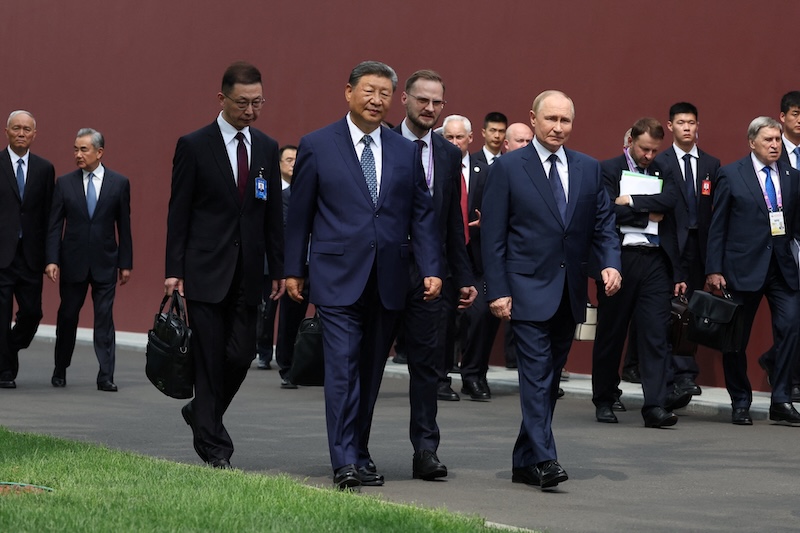
In this context, Iranian President Massoud Pezeshkian attended the Shanghai Cooperation Organization (SCO) summit in Tianjin, northern China, seeking political backing from Moscow and, especially, Beijing.
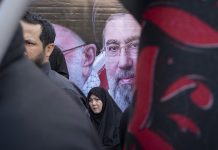
Before departing Tehran, Iran’s Supreme Leader Ali Khamenei instructed Pezeshkian to focus solely on securing support from these two key allies.
The significance of the summit was best captured by Kaja Kallas, the European Union’s High Representative for Foreign Affairs and Security Policy.
She described the joint appearance of Chinese, Russian, North Korean, and Iranian leaders in a Beijing military parade as more than symbolic — labeling it an emerging “authoritarian alliance” designed to challenge the international rules-based order. She said this demanded a serious response from the West.
Iran’s Supreme Leader Ali Khamenei has been pursuing a ‘Look East’ policy to counter the West’s strategy of maximum pressure ahead of a possible resumption of sanctions. Yet the East appears more invested in maintaining relations with Israel and the Gulf states than with the Islamic Republic. Beijing and Moscow continue to use Iran as a bargaining chip in their broader negotiations with the West, rather than as a true strategic partner.
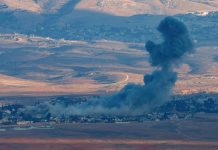
During the recent 12-day Iran-Israel conflict, both China and Russia issued only mild condemnations of Israel’s attacks on Iran.
The recent Tianjin summit and Pezeshkian’s meetings with Chinese and Russian officials yielded little beyond symbolic support. Pezeshkian was unable to secure a commitment from China to keep buying Iranian oil at steeply discounted rates if sanctions are reimposed.
Although SCO members — especially China and Russia — recognize the strategic importance of the Islamic Republic’s survival given its geopolitical position, their support remains largely symbolic and lacks meaningful substance.
The Tianjin gathering was one of the most consequential in the SCO’s history.
Alongside the ten full member states, ten other countries — including Turkey and Saudi Arabia — participated either as observers or aspirants.
Many attendees advocated for fast-tracking Turkey and Saudi Arabia’s accession, arguing that their membership would elevate the SCO’s global influence — politically, economically, and strategically.
Founded in 2001 by China, Russia, Kazakhstan, Kyrgyzstan, Tajikistan, and Uzbekistan, the SCO has since expanded to include Iran, India, Pakistan, and Belarus, positioning itself as a counterweight to Western-led alliances.
In its current form, the SCO represents 2.5 billion people and a combined economic output of $30 trillion — roughly 40 percent of global GDP — making it a geopolitical force that cannot be overlooked. However, Iran’s trade with other SCO members remains marginal.
Even though China is the primary — and almost exclusive — buyer of Iranian oil, U.S. sanctions compel Iran to sell oil at a discount of $6 to $12 per barrel. With daily exports of around 1.4 million barrels, this translates into a loss of $8.4 to $16.8 million per day, or more than $6 billion annually, compared to open market prices.
Iran does not receive dollars or euros in return but Chinese yuan — a currency that can only be spent within China.
Tehran is particularly concerned that if international sanctions are reinstated in October and strictly enforced, China could easily shift to alternative suppliers. For Iran, finding a new buyer for 90 percent of its oil exports would be extraordinarily difficult.
Ahead of President Pezeshkian’s visit to Beijing, Khamenei posted on X (formerly Twitter) in Persian and Chinese, framing the trip’s objectives: “Iran and China, with their ancient civilizations on opposite ends of Asia, have the power to transform the regional and global landscape. Operationalizing all dimensions of the strategic partnership agreement will pave the way.”
This referred to the 25-year strategic agreement signed by Iran and China in March 2021 — a deal that remains largely symbolic. Beijing has yet to deliver on any of its promised investments, and its economic presence in Iran has diminished under the weight of U.S. sanctions.
Though China pledged — alongside Russia — to oppose the reimposition of international sanctions, it stopped short of offering any practical assistance to help Iran bypass them, particularly in the military sphere.
Tehran’s requests for military support have so far gone unanswered.
China has made it clear to Iran that it will not pursue any military cooperation that could endanger its ties with Israel or the Gulf Arab states.
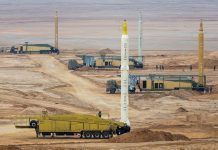
However, there are indications that North Korea — whose leader Kim Jong Un visited China at the same time as Pezeshkian — may, under the mediation of President Xi Jinping, collaborate with Iran’s Islamic Revolutionary Guard Corps (IRGC) on missile development.
Although military cooperation between China and Iran began in the 1980s and has never fully stopped, it has remained limited and largely secret — focusing mainly on missile guidance components and drone technology.
Earlier this year, the U.S. Treasury Department sanctioned several Chinese firms for their role in such exchanges. North Korea has also, in the past, transferred Chinese military technology to Iran.
Iran had hoped to import solid missile fuel from China, but that request was reportedly denied.