
By Ahmad Rafat
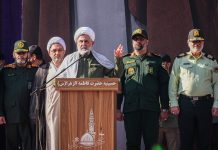
In late June, Brigadier General Esmail Ghaani, commander of the Islamic Revolutionary Guard Corps Qods Force (IRGC-QF), made an unannounced visit to Baghdad.
At the same time, representatives from several groups, including Lebanon’s Hezbollah, Yemen’s Houthis (Ansar Allah), Palestine’s Hamas and Islamic Jihad, Hezbollah Al-Hejaz (Saudi Party of God), and Bahrain’s Saraya al-Makhtar, also arrived in the Iraqi capital.
These groups, along with members of the Iraqi Popular Mobilization Forces (PMF), reportedly convened for a two-day meeting with General Ghaani.
The meeting ended with the formation of a committee to coordinate the activities of these groups, many labeled as terrorist organizations internationally.
The committee’s headquarters will reportedly be in Najaf, southern Iraq.
Though details from the closed-door discussions remain scarce, it has been revealed that the so-called Axis of Resistance decided to operate under the banner of the Islamic Republic moving forward, coordinating efforts with one another and the IRGC-QF.
The Axis of Resistance is a loose coalition of militant and political groups across the Middle East, supported by the Islamic Republic. Established by the regime, the alliance brought together factions dedicated to opposing U.S. and Israeli influence in the region. Key members include Hezbollah in Lebanon, the Islamic Resistance in Iraq, the PMF, and the Houthis in Yemen.
The coalition occasionally includes Hamas and several other Palestinian militant organizations.
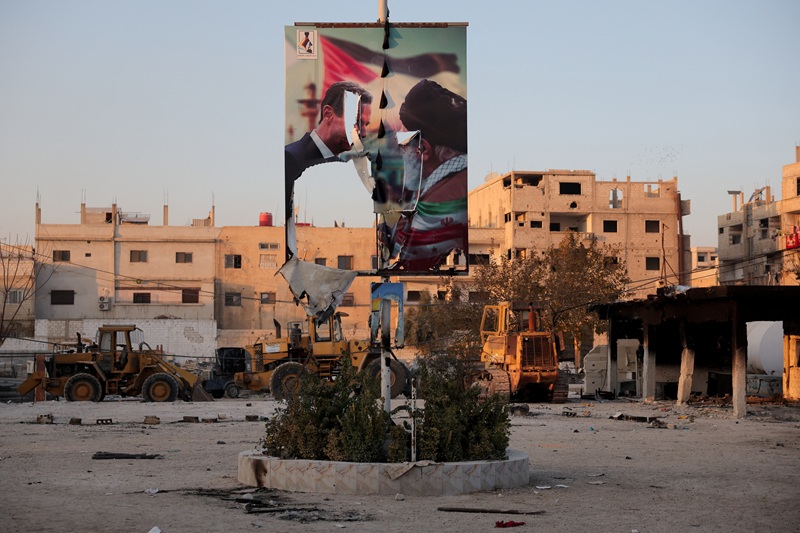
The Axis of Resistance has faced setbacks due to the Gaza war and the Israel–Hezbollah conflict. Furthermore, the collapse of Syrian President Bashar al-Assad’s regime caused additional disruption to the network.
SPECIAL REPORT – Iran Had Imperial Ambitions in Syria. Secret Embassy Documents Show Why It Failed
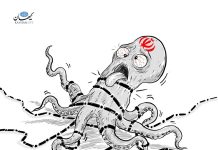
In response to Israeli attacks on its proxy forces over the past year and a half, the Islamic Republic has been working to re-establish the Axis of Resistance, a critical tool in its strategy for regional instability, particularly aimed at increasing pressure on Israel.
Following the meeting, negotiations between various groups and their home countries’ governments have taken a new turn.
Hezbollah, which had previously been in talks with Lebanese President General Joseph Aoun about potentially surrendering its weapons, announced that it would not comply under the current conditions.
Hezbollah’s Secretary-General, Naim Mohammad Qassem, also made it clear that the group would not honor the proposed agreement put forward by Thomas Barrack, the U.S. special envoy for Syria.
During the Ashura ceremonies on July 4, Qassem firmly rejected the idea of handing over Hezbollah’s missiles to the Lebanese army. He stated, “These missiles are the foundation of our defense power,” and reiterated the group’s commitment to resisting Israel.
In response to Qassem’s remarks, Israel launched fresh attacks on Hezbollah-controlled regions, despite an existing ceasefire agreement brokered by the U.S. in November of the previous year, resulting in the deaths of several Hezbollah commanders.
Considering these developments, the Trump administration has set November 2025 as the final deadline for Hezbollah to disarm, coinciding with the first anniversary of the ceasefire agreement with Israel.
Negotiations between the forces within the PMF and the Iraqi government led by Prime Minister Muhammad Shayya al-Sudani, regarding the full integration of these forces into the national army, have stalled following a recent meeting in Baghdad that included Commander Ghaani.
Several PMF factions — such as Kata’ib Hezbollah (Hezbollah Brigades), Harakat Hezbollah al-Nujaba (HHN), and Asa’ib Ahl al-Haq (AAH, or the Khazali Network) — which remain loyal to the Islamic Republic, have signaled their willingness to strengthen the Axis of Resistance once more.
An Iraqi source told Kayhan Life that AAH, under the leadership of Qais Hadi Sayed Hasan al-Khazali, is poised to take charge of coordinating the newly formed Axis of Resistance committee in Najaf.
Shortly after the Baghdad talks, the Houthis in Yemen renewed their missile strikes on Israel. On July 10, 12, and 15, the Houthis launched multiple missiles at Israel. Concurrently, their attacks on commercial ships in the Red Sea also intensified.
In their most recent attack on July 9, the Houthis targeted the Greek-operated cargo ship Eternity C, which was sailing under the Liberian flag with 25 crew members on board. The assault, involving rocket-propelled grenades fired from small boats, resulted in the ship sinking and the deaths of three crew members, according to the UK Maritime Trade Operations (UKMTO) agency.
For a while, Houthi attacks on commercial ships had significantly dropped, mainly because many of these incidents were more symbolic than strategic.
However, the recent assault on a Greek commercial vessel, resulting in casualties, indicates that the Houthis — likely in coordination with the Islamic Republic — are once again prepared to pose a serious threat to shipping in the Red Sea.
Additionally, the participation of armed Shiite groups from Bahrain and Saudi Arabia in the Baghdad meeting spells trouble for the southern Gulf states.
In the past, groups like Hezbollah Al-Hejaz (the Party of God in the Hejaz) and Saraya al-Makhtar carried out sabotage operations that destabilized the security of Saudi Arabia and Bahrain.
The revival of these groups’ activities, along with other armed factions backed by the IRGC-QF, could pose significant challenges for the Gulf kingdoms, especially in the current volatile climate.