Prominent Defense Lawyer Alikordi Found Dead; Rights Groups Cite Signs of Violent Assault
By Kayhan Life, Kayhan London Staff
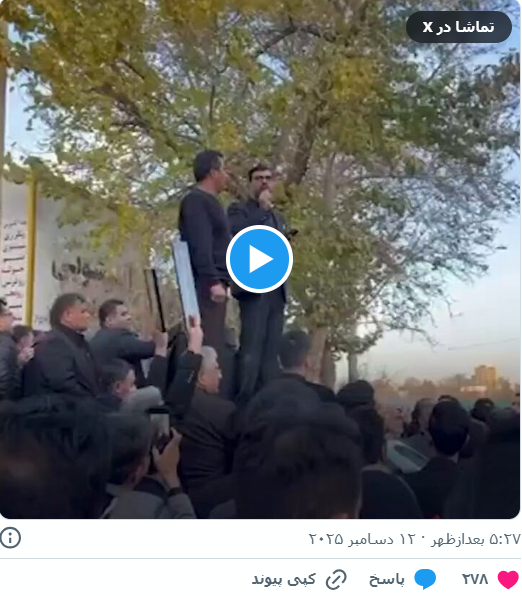
A memorial service for a prominent defense attorney in the northeastern Iranian city of Mashhad turned into a large anti-government demonstration on Saturday, as thousands gathered to honor him it erupted into rare, openly monarchist chants before security forces moved in violently.
The ceremony for the lawyer, Khosrow Alikordi, held a week after his death at the Ghadir Mosque, quickly turned into a political rally. Mourners chanted “An Iran without a Shah has no order,” and “O Shah of Iran, return to Iran”—slogans that signal the growing visibility of monarchist sentiment in public spaces, despite decades of official suppression.
Public demonstrations in Iran remain highly restricted, and open criticism of the Islamic Republic—especially support for the former monarchy—can carry severe legal and physical consequences. Mashhad, Iran’s second-largest city and a major site of religious pilgrimage, is typically under tight security control. Large anti-government gatherings there are rare, making Saturday’s turnout and the explicit monarchist chants particularly striking.
Political and civil society activists attended the memorial alongside families of protesters killed during the 2022 nationwide uprising that became known as the “Woman, Life, Freedom” revolution. Triggered by the death of Mahsa Zhina Amini in police custody, it captured international attention as a momentous challenge to the Islamic Republic’s authority, not witnessed since 1979.
After a tribute by the lawyer’s brother, Javad Alikordi, the imprisoned Nobel Peace Prize laureate Narges Mohammadi addressed the crowd. Standing on a car with a microphone without the mandatory veil, she paid tribute to Majid Reza Rahnavard, a 23-year-old monarchist, who was executed after being convicted of “enmity against God” in connection with the fatal stabbing of two members of the Basij paramilitary force.
Iran’s Regime Carries Out Second Execution Linked to Wave of Popular Protests
Amnesty International said he was sentenced after a single-session trial before a Revolutionary Court in Mashhad, raised serious concerns that he was subjected to torture, and noted that he was hanged just 23 days after his arrest.
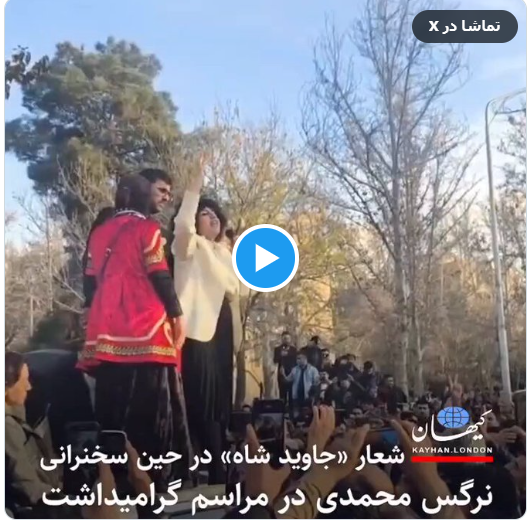
As Mohammadi spoke, chants of “Long live Iran” and “Long live the Shah” continued, reflecting the growing visibility of monarchist sentiment in public protests.
The crowd also chanted “ Woman Life Freedom”, “death to the dictator”, a reference to Supreme Leader Ayatollah Ali Khamenei, as well as: “No Gaza, no Lebanon, my life only for Iran,” “We fight, we die, we accept no humiliation”.
Among those present was Tayebeh Nazari, a lawyer and relative of a slain protester, who praised Alikordi for his work defending bereaved families. Her emotional remarks circulated widely on social media.
But the gathering soon drew a heavy security response. Riot police charged the crowd, firing tear gas and pellet rounds and beating mourners. Mashhad Prosecutor announced 39 arrests, including Mohammadi, Sepideh Gholian, and Pouran Nazemi. Haidar Chah Chamandi, a monarchist activist and former political prisoner, was detained after reciting verses from the epic poetry of Shahnameh while visibly bleeding from injuries inflicted by security forces.
Security forces initially failed to arrest Javad Alikordi amid resistance from the crowd. Hours later, he warned publicly that he would release confidential information about his brother’s death if detainees were not freed. He was arrested later that night and taken to an undisclosed location. Reporters Without Borders said four journalists were also arrested.
Prince Reza Pahlavi, the exiled son of Iran’s last monarch and a figurehead for large segments of the opposition abroad, responded on Saturday, praising the demonstrators. “I appreciate your courage and thank you for your valuable support,” he said in a statement. He called for the “unconditional release” of those detained and added, “Victory will be yours.”
The Norwegian Nobel Committee called on Iranian authorities “to immediately clarify Mohammadi’s whereabouts, ensure her safety and integrity, and to release her without conditions”.
While monarchist sentiment did not disappear after the 1979 revolution that toppled the Pahlavi dynasty and ushered in clerical rule, it has grown more visible in recent years—especially among younger Iranians disillusioned with economic stagnation, social restrictions, and political repression. Chants invoking the former shah or his exiled son have surfaced sporadically during protests since at least 2017, though the government continues to characterize such expressions as foreign-instigated.
Reza Pahlavi Urges the West to End ‘Appeasement’ and Support Iranians’ Push for Democracy
State-affiliated media later portrayed the unrest at the memorial as the work of “hostile elements,” pointing to monarchist slogans as evidence of outside agitation. Judiciary-linked outlets claimed that several police officers were injured.
Alikordi, a well-known lawyer who represented families of protesters killed during the 2022 crackdown, died on Dec. 5 under circumstances widely regarded as suspicious. Authorities attributed his death to a heart attack, but activists and colleagues have expressed deep skepticism, citing what they describe as evidence of an organized killing.
Suspicious deaths of activists, journalists, and lawyers are not unprecedented in Iran, where state institutions maintain sweeping powers of surveillance and detention. Growing public distrust of the Islamic Republic has fueled repeated cycles of unrest, each more visible than the last.
The confrontation at Alikordi’s memorial underscores that skepticism and highlights how even mourning rituals—typically among the few remaining public spaces for collective expression—can quickly become flashpoints for broader challenges to the Islamic Republic’s authority.