By Kayhan Life Staff
U.S. President Donald Trump said Iran’s clerical state could collapse, in an interview with Reuters at the White House on Jan. 15, reiterating that he supported Iranians who had taken to the streets.
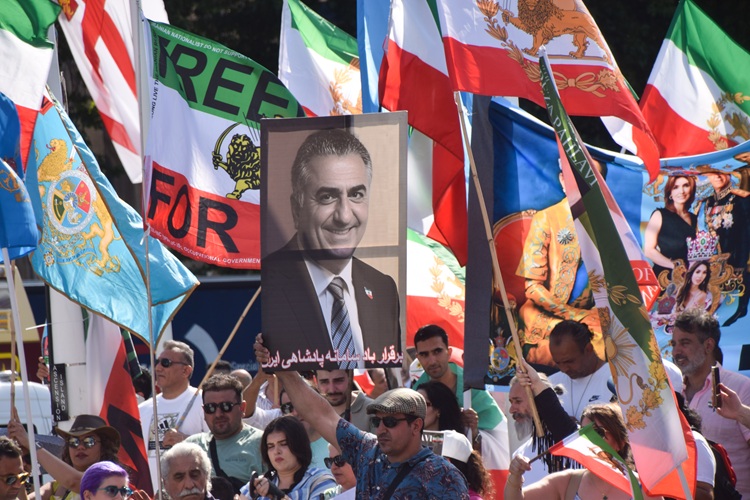
Those demonstrations unfolded amid growing public supoort for Prince Reza Pahlavi, the exiled son of Iran’s last shah, across multiple cities inside the country.
Reuters noted that Trump had previously stopped short of offering explicit backing to Pahlavi. In the interview, he struck a cautious note while leaving the door open. “He seems very nice, but I don’t know how he’d play within his own country,” Trump said. “And we really aren’t up to that point yet.
He added, “I don’t know whether or not his country would accept his leadership, and certainly if they would, that would be fine with me.”
Millions Rally Across Iran After New Protest Calls by Prince Reza Pahlavi
Prince Reza Pahlavi : ‘The Alternative to the Islamic Republic is the Iranian nation’
The remarks came as signs emerged of quiet contacts between figures close to Trump and the Iranian opposition. Citing a senior American official, Axios reported on Jan. 12, that Steve Witkoff, Trump’s Middle East envoy, had held a confidential meeting with Reza Pahlavi over the previous weekend to discuss the scope and direction of the protests in Iran. No further details of the meeting were disclosed.
The same official said the U.S. administration had been surprised by the prominence of Pahlavi’s name in protest chants inside Iran. “We witnessed a rise in Pahlavi’s standing,” the official said. “In many cities, his name was shouted during demonstrations, and it appeared to have developed spontaneously.”
Iran has faced repeated waves of unrest, in particular since 2017, driven by economic hardship, political repression, and anger at the ruling system. A 2025 survey by the Iranian Students Polling Agency (ISPA) operating under the Supreme Council of the Cultural Revolution (SCCR) indicated that public dissatisfaction with the country’s situation had reached 92 percent.
The latest round began on Dec. 28, when shopkeepers and bazaar merchants in Iran’s major cities staged coordinated protests as the currency plunged to a new record. On Jan 5, 2026, Pahlavi issued his first public call to action in response to mass killings by state forces,
The Iranian diaspora has gathered in several world capitals outside U.S. diplomatic missions, urging Washington to offer tangible support to Iranians facing repression by the Islamic Republic, after Pahlavi called on Iranians abroad to mobilize and outlined what he described as a post–Islamic Republic vision for Iran’s national security, foreign policy, diplomacy, and economy. He said a free Iran would act as a “reliable friend” and a stabilizing force in the region and beyond.
He argued that Iran’s international position would undergo a fundamental transformation after the fall of the current system. According to his statements, Iran’s military nuclear program would be fully halted, and support for militant groups would end immediately. He said a post–Islamic Republic Iran would cooperate with regional and global partners to combat terrorism, organized crime, drug trafficking, and extremism.