By Kayhan Life Staff
A global project to digitally reassemble the complete Shahnameh of Shah Tahmasp – the priceless 16th-century Persian manuscript which was dismembered in the 1960s — is due to be publicly launched at an event in London on October 10. The project is led by Dr. Zahra Faridany-Akhavan and her son Arsalan Akhavan, who are hosting the event.
The project, titled “Healing History: Reuniting the King’s Book of Kings,” is the result of four decades of academic research and analysis by Dr. Faridany-Akhavan to digitally reunite hundreds of folios – illustrations and text – of the Book of Kings with the help of collectors and institutions worldwide.
Trading Shahnameh for De Kooning: New Memoir Recounts Historic 1994 ‘Exchange’
Dr. Faridany-Akhavan is an art historian and expert on the Shahnameh of Shah Tahmasp, considered one of the world’s greatest art-historical treasures. Her PhD thesis at Harvard University focused on manuscript reconstruction. Her son Arsalan Akhavan, an actor and comedian who is the founder & CEO of Rug Entertainment, led the initiative to transform this research into a multimedia cultural heritage experience.
The goal of the Oct. 10 London preview (to be held at 7 pm in the Library of the University Women’s Club in Mayfair) is to raise awareness of this initiative and attract interest and support for a traveling exhibition, funded by a collaborative group of heritage-preserving backers. No physical folios of the Shahnameh will be presented at the event.
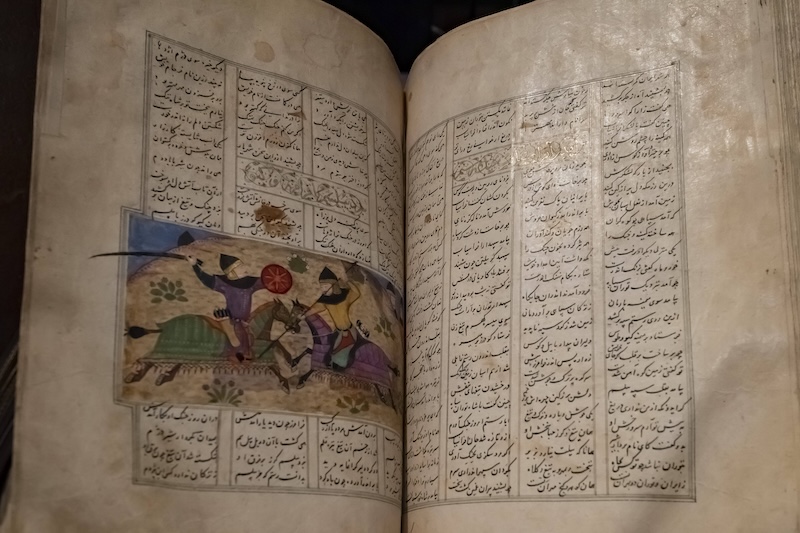
The Shahnameh of Shah Tahmasp, or “Shahnameh-ye Shahi,” was commissioned in the 16th century by Shah Ismail – founder of the Safavid dynasty – as a present for his son and successor, Tahmasp.
The 759-page manuscript contained a total of 258 miniatures, and was realized over two decades at the royal atelier in Tabriz by some of the most renowned artists of the time. It was subsequently presented by Shah Tahmasp to the new Ottoman ruler, Sultan Selim II, and remained for centuries in the Ottoman royal library of the Topkapi Palace in Istanbul, before appearing in Edmond James de Rothschild’s collection in 1903.
The carefully preserved manuscript remained intact until its sale by Rothschild’s grandson in 1959 to Arthur A. Houghton Jr. – heir to the Corning Glass Works fortune, and a longtime chairman of the Metropolitan Museum of Art and the New York Philharmonic Orchestra. Houghton initially acquired the manuscript as a possible gift for Harvard University. He then decided to keep it, had it unbound and photocopied by a respected Harvard curator in 1964, and proceeded to dismember it.
Houghton donated 76 folios with 78 miniatures to the Metropolitan Museum as a tax-deductible gift in 1970. He auctioned seven other folios off in 1976, and another 14 in 1988, and sold other pages through art dealers.
In October 2022, a single page of the Shahnameh illuminated manuscript was sold at Sotheby’s London for $9.4 million.
When Houghton died in 1990, only 118 miniatures survived. His son Arthur Houghton III chose to sell what was left of the manuscript – meaning 500 pages of calligraphy – in its exquisite original binding.
Starting in 1991, Arthur Houghton III, a foreign-service official then working for the administration of U.S. President Bill Clinton, engaged in secret negotiations with Iranian officials through the late British art dealer Oliver Hoare.
After three years, an agreement was finally reached. On July 27, 1994, the Shahnameh was traded for the American Abstract Expressionist painter De Kooning’s “Woman III” on the Vienna airport tarmac, and returned to Iran.
Today, pages of the priceless illuminated manuscript are in such museums and private collections as the Metropolitan Museum of Art in New York, the Aga Khan Museum in Toronto, the Museum of Islamic Art in Doha and the Louvre Abu Dhabi, the Khalili Collections and the Sarikhani Collection in London, the Farjam Collection in Dubai, and the Soudavar Collection in Washington, D.C.
Arsalan Akhavan’s short documentary “Billion dollar Masterpiece: Reuniting the Shahnameh of Shah Tahmasp” documents the history of the Shahnameh of Shah Tahmasp and Dr. Faridany-Akhavan’s reconstitution project and is available on YouTube at: