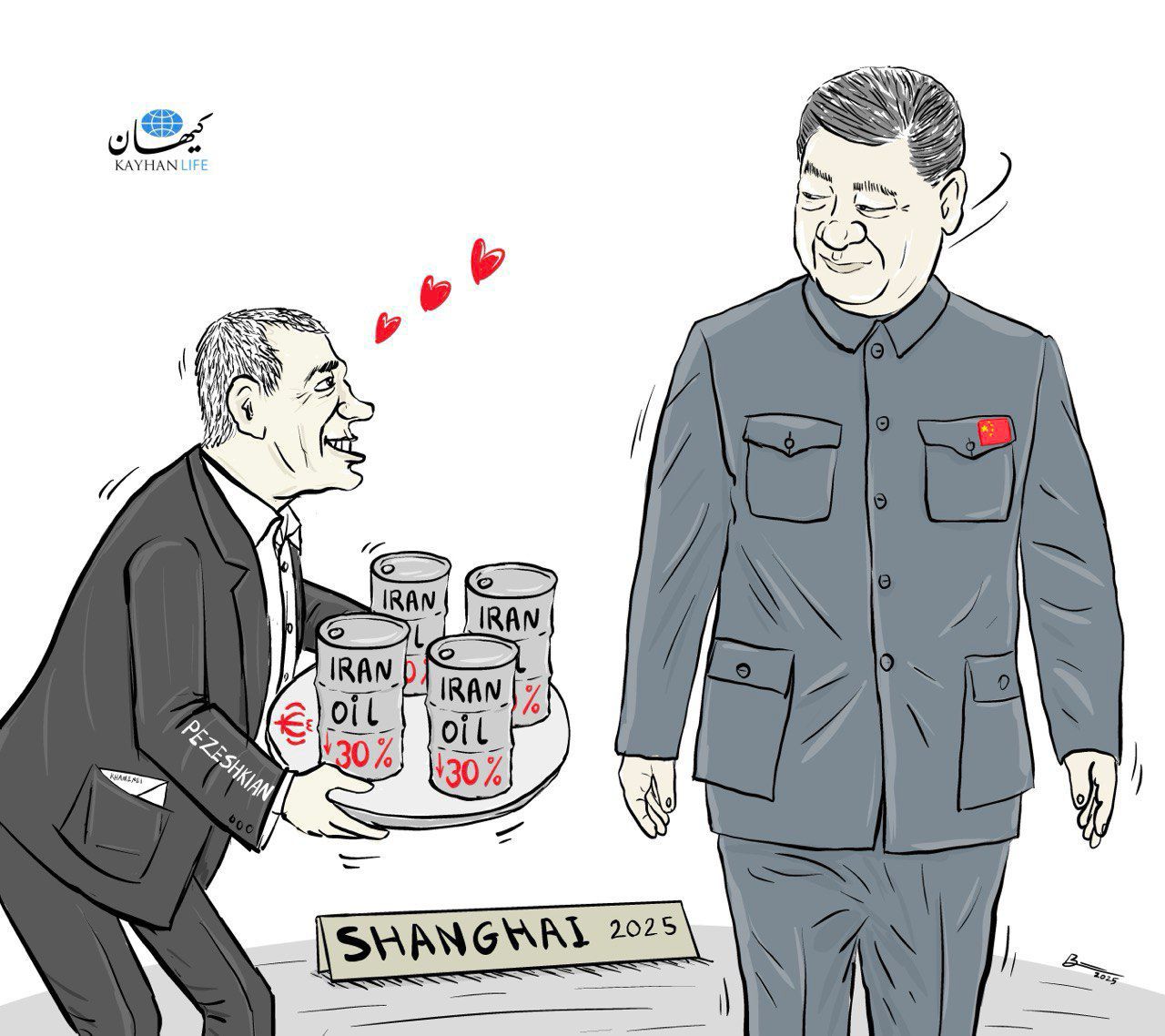
Artist: Behnam Mohammadi
By: Kayhan Life Staff
The Shanghai Cooperation Organization summit kicked off on August 31, with 20 leaders smiling for the cameras. Missing from the all-important family photo, however, was Masoud Pezeshkian, president of the Islamic Republic—absent apparently because the regime’s nemesis, alcohol, was on the menu.
Mr Pezeshkian’s public relations guru maintained that the story was simple: the flight was late and the summit hadn’t technically begun. Unofficially, sources whispered that Pezeshkian timed his arrival with surgical precision. That way, he could skip the banquet without being photographed near a glass of alcohol.
The theocratic state has perfected this art of absence. In bilateral visits, hosts quietly remove the alcohol from the table. But at multilateral banquets, there is no negotiation.
The next day, Pezeshkian was relegated to the second row of the photo op, behind luminaries like North Korea’s Kim Jong-un. For a leader keen to prove his international gravitas, it was unflattering.
Back in Tehran, Ayatollah Ali Khamenei tried to salvage dignity with a tweet about the “25-year strategic cooperation agreement” with Beijing. “Together, our ancient civilizations will transform the world,” he declared. The message was dutifully reposted in Chinese. In reality, Beijing has treated the Islamic Republic less like an “ancient civilization” and more like a bargain-basement gas station: fill up the tank on the cheap and drive away.
That $400 billion of promised Chinese investment? It has vanished into the same black hole as Iran’s economic reforms. Between 2018 and 2022, China invested 37 times more in Saudi Arabia and 31 times more in the UAE than in the Islamic Republic. Beijing may respect Iranian poetry, but when it comes to money, it prefers Riyadh’s balance sheets.
Customs data tell the story: Chinese exports to Iran are up 52%, while imports from Iran are down 41%. Translation: Beijing sells Tehran cheap electronics, plastic toys, and construction equipment—and buys less and less of its oil. Russia, once Iran’s comrade in sanctions, is already outcompeting Tehran in China’s energy market.
Still, the Islamic Republic clings to its “look East” doctrine like a gambler at a rigged roulette table. Khamenei and his inner circle insist that joining BRICS or SCO will somehow offset sanctions. The reality is simpler: Beijing loves Iran’s oil discounts, but has no interest in underwriting the costs of the theocratic state’s defiance.
Ordinary Iranians, of course, see this for what it is. They know the difference between their country—Iran, with its culture, history, and people—and the Islamic Republic, brutal but inept with a knack for turning diplomacy into self-inflicted pratfalls.