By Kayhan Life Staff
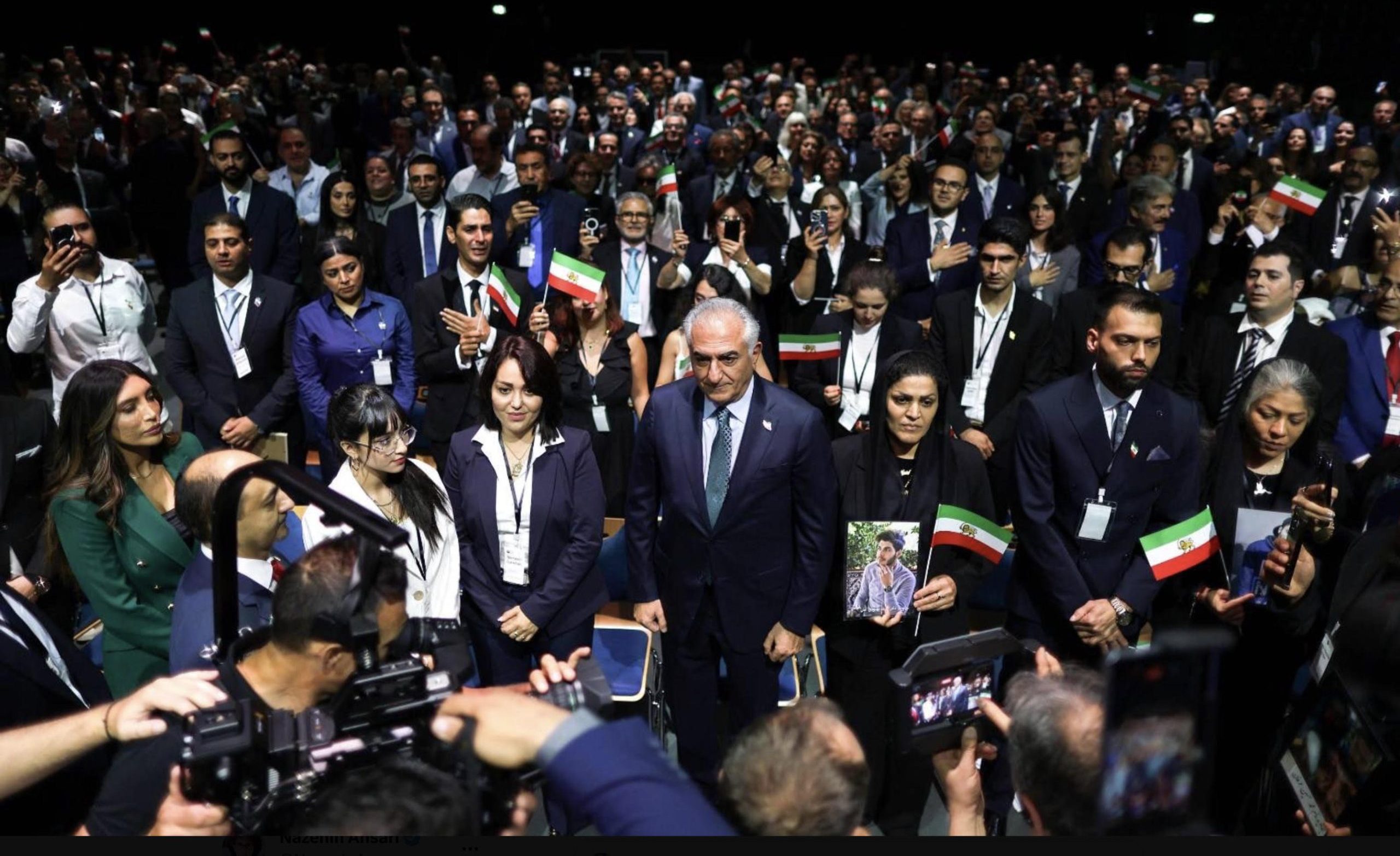
In what participants described as the most inclusive Iranian opposition gathering in decades, more than 500 exiled political activists, intellectuals, former prisoners, civil society leaders, and public figures convened on Saturday July 26 at the “National Cooperation to Save Iran” conference in Munich, Germany.
Hosted by Crown Prince Reza Pahlavi, the event at the Infinity Hotel – which lasted more than 12 hours — set out to establish a unified resistance movement against the Islamic Republic, and lay the groundwork for a democratic, secular Iran. The Prince was accompanied by his daughter Noor Pahlavi, and engaged with attendees in a display of solidarity.
The conference featured both in-person speeches and video messages from a host of prominent personalities, including former Empress Farah Pahlavi, Nobel Peace Laureate Shirin Ebadi, singer Googoosh, and chess grandmaster Mitra Hejazipour.
Participants ranged from human rights advocates, academics, and athletes to LGBTQ+ activists, legal experts, and former military officers. Many had been imprisoned or injured by the regime, or had lost loved ones in recent waves of nationwide protests.
Among the athletes in attendance were the former boxing team captain Salar Gholami and the karate coach Reza Azizi, demonstrating the movement’s reach outside of political circles.
LGBTQ representative Mana Mandegar gave an emotional speech demanding inclusivity. “No national project to save Iran can call itself comprehensive if it refuses to hear our voices and recognize our rights,” she said.
The business world was also well represented.
Iranian-American entrepreneur Shervin Pishevar, former executive chairman of Hyperloop One, shared a bold vision for Iran’s economic rebirth—one rooted in innovation, global cooperation, and the boundless potential of a free Iranian people.
Munich, July 26— At the “Iran Rising” National Cooperation Convention hosted by Crown Prince Reza Pahlavi, Iranian American entrepreneur and philanthropist Shervin Pishevar addressed attendees with a message of remembrance and renewal.
Pishevar, known for his work as a tech… pic.twitter.com/xNA0YywBqR— Kayhan Life (@KayhanLife) July 28, 2025
Iranian-American executive Hamid Moghadam, CEO of Prologis and a board member at Stanford Management Company, delivered a sharp economic critique of the Islamic Republic. “Iran is not a poor country—but it has been run like one,” he said. He blamed systemic mismanagement for leaving a resource-rich nation struggling under the weight of corruption and incompetence.
In his keynote address, Reza Pahlavi unveiled a roadmap for transitional governance in a post-regime Iran. His two-part proposal calls for a temporary executive team and a National Uprising Council to serve in an advisory legislative role until free and fair elections can be held in Iran. He also announced the upcoming launch of a digital platform for coordinating activism, fundraising, and outreach efforts.
“This is our historic moment,” Pahlavi said. “We are here to show that our diverse nation—across faiths, ethnicities, and ideologies—stands united in ending the Islamic Republic and ushering in a new dawn of freedom.”
In a direct message to Iran’s Supreme Leader Ali Khamenei, the Prince said: “The people have rejected you. Even those closest to you are waiting to abandon this sinking ship.”
He rejected all forms of revenge and reaffirmed his commitment to a peaceful transition. Later, he told those present: “I seek no title—I am only a father. And fatherhood requires no crown.”
One of the most poignant moments of the day came when political prisoners held in Greater Tehran Prison sent an audio message declaring their support for the conference and endorsing Pahlavi’s mission to guide Iran toward a secular and democratic future. Their message, smuggled out under difficult conditions, drew sustained applause from the audience.
Several speakers who had taken part in the 2022-23 protest movement shared deeply personal accounts.
Munich, Germany — July 26, 2025
At the Convention of National Cooperation held in Munich, Esmat Vatanparast, widely known as “Mother Esmat,” delivered a poignant address reflecting decades of personal loss and enduring advocacy.Vatanparast, whose family was deeply affected by… pic.twitter.com/XSINpsAEp8
— Kayhan Life (@KayhanLife) July 27, 2025
Pouya Alipour, known as the “Boy from Nazi Abad,” survived a brutal beating by regime agents and brought with him audio messages from Hossein Naderbeigi, who was blinded in both eyes by pellet shots, and the father of 18-year-old Nima Nouri, who was shot and killed during a memorial for slain protester Hadis Najafi.
“These stories are not just tragedies—they are the reason we’re here,” Alipour said, urging the audience not to let the victims’ sacrifices be in vain.
Mahan Mehrabi, sister of the political prisoner Mahmoud Mehrabi, offered a hopeful reflection on the meaning of national cooperation: “For me, it means dialogue instead of hatred, inclusion instead of rejection, building bridges instead of division.”
Former police officer Fariborz Karami Zand, in turn, addressed Iran’s military directly, urging them to uphold their duty to the nation, not the regime. “The Islamic Republic has brought the fire of war into our homes,” he said. “If you remain complicit, you place yourselves among the enemies of Iran.”
Dr. Shirin Ebadi – who was awarded the Nobel Peace Prize in 2003 for her pioneering efforts in advancing democracy and rights for women, children, and refugees – appeared in a video message and echoed Pahlavi’s call for collective action. “Today is a time for choosing,” she said. “We will either succeed through unity or be defeated in isolation.”
She dismissed the notion of reform via referendum under the current regime as “meaningless,” stressing that change could only come once the Islamic Republic was dismantled.
شیرین عبادی:
امروز زمان انتخاب است!
یا با اتحاد پیروز خواهیم شد؛ یا در انزوا شکست خواهیم خورد!یکی از مهمانان نشست «همایش ملی برای نجات ایران»، شیرین عبادی حقوقدان و برنده جایزه صلح نوبل بود. او نیز بر ضرورت اتحاد برای سرنگونی جمهوری اسلامی تأکید کرد و گفت که رفراندوم تا این… pic.twitter.com/dS50SPPy4s
— KayhanLondon کیهان لندن (@KayhanLondon) July 28, 2025
German lawmaker Danial Ilkhanipour of the Social Democratic Party called out both Western inaction and the opposition’s historical fragmentation. “We must move beyond this madness,” he said, referencing the failure to break free from cycles of ineffective diplomacy and infighting. “A free and democratic Iran—or a regime with even more brutality. The choice is yours.”
دانیال ایلخانیپور نماینده سوسیال دموکرات پارلمان هامبورگ:
انتخاب با شماست!
ایران آزاد و دموکراتیک یا رژیم با بیرحمی بیشتر؟!دانیال ایلخانی پور @ilkhanipour عضو پارلمان هامبورگ از حزب سوسیال دموکرات آلمان یکی از مهمانان و سخنرانان نشست «همکاری ملی برای نجات ایران» در مونیخ… pic.twitter.com/yQwmdl76sF
— KayhanLondon کیهان لندن (@KayhanLondon) July 29, 2025
In a post on X (formerly Twitter), political analyst Ali Hossein Ghazizadeh added his voice to the growing calls for unity. He argued that only a leader untainted by the regime—namely Reza Pahlavi—can credibly lead a democratic transition.
Ghazizadeh criticized former regime insiders who now position themselves as opposition figures despite their failure to attract public support. While they may still contribute to the movement, he wrote, “that role should be to support a figure trusted by the people.”
The event was organized by Munich Circle, a nonprofit that oversees logistics and planning. In opening remarks, the group’s representative, Ali Khosroshahi, thanked Crown Prince Pahlavi and welcomed attendees with a stirring message: “History is watching us. Let it witness our rise and unity.”
The Munich conference also underscored the challenges ahead: how the opposition can sustain unity, avoid factionalism, and reach audiences inside Iran amid censorship, surveillance, and intimidation.
The event marked a turning point — from a fragmented resistance to an expanding coalition focused on shared goals, strategy, and dialogue. The defining test of the movement’s future is whether that momentum can be translated into real change on the ground, analysts said.
Regime Change Is Only Solution For Iran, Say DC Conference Speakers
Prince Reza Pahlavi : ‘The Alternative to the Islamic Republic is the Iranian nation’