By Kayhan Life Staff
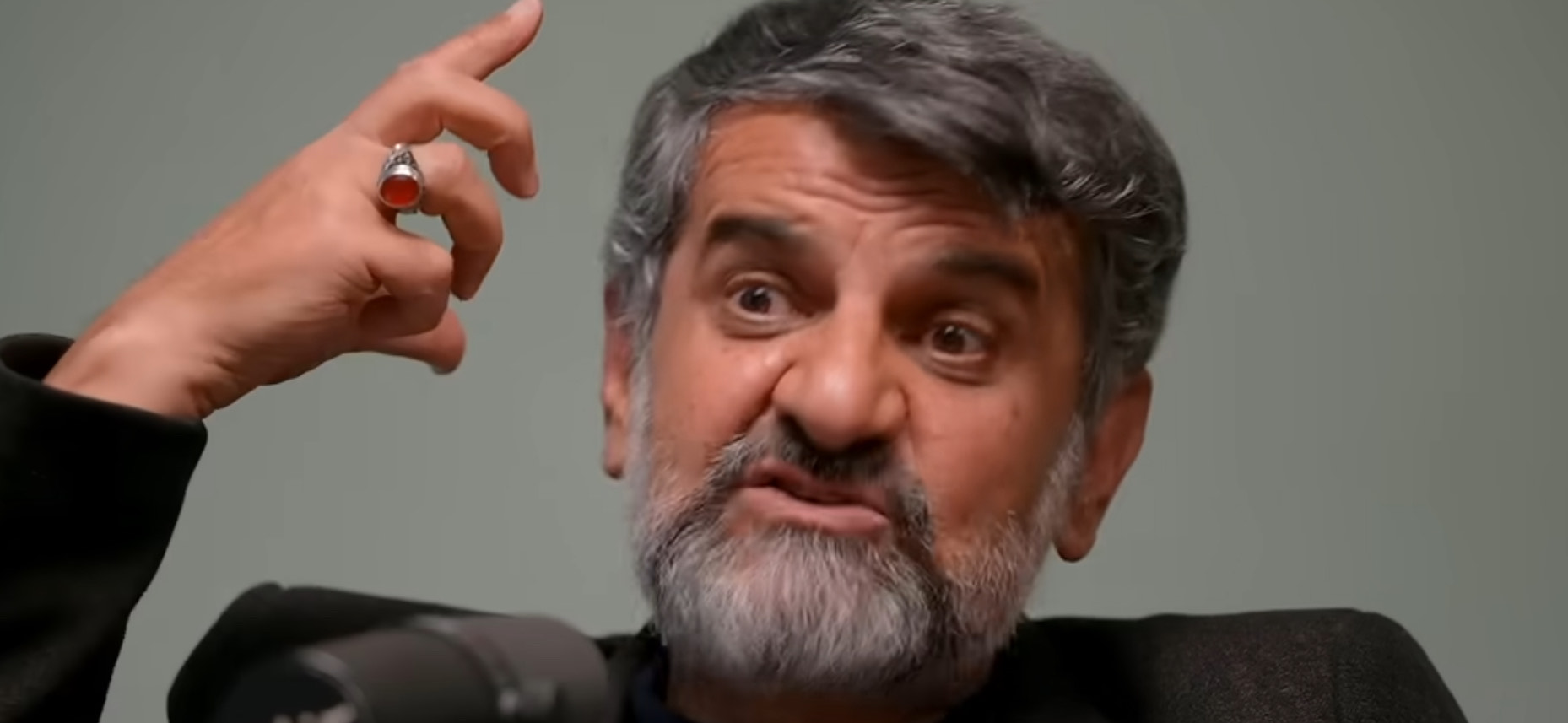
Mehdi Nasiri, a longtime Islamic Republic loyalist and the former editor-in-chief of the hardline Tehran-based Kayhan newspaper, has delivered a damning assessment of the regime and an optimistic vision for Iran’s post-theocratic future.
In a wide-ranging interview with Nazenin Ansari, managing editor of Kayhan London and Kayhan Life, Nasiri — who for many years edited the flagship daily overseen by Supreme Leader Ali Khamenei — spoke about the Islamic Republic’s moral, political, and institutional decline. The former regime insider argued that the fall of the Islamic Republic was not only inevitable but essential for Iran’s rebirth.
Commenting on Supreme Leader Ali Khamenei’s delayed public appearance following Israeli airstrikes that killed several top officials during the Twelve-Day War in June 2025, Nasiri said the silence — and the dramatic staging of the patriotic anthem Ey Iran — were signs of desperation.
“Dictators always stage a show of power right before the collapse,” he said, comparing Khamenei’s reemergence to the final public appearances of Iraqi Leader Saddam Hussein and Libyan Leader Muammar Gaddafi. The use of a nationalist anthem — long denounced by the regime as un-Islamic — underscored, in Nasiri’s view, the Islamic Republic’s growing ideological incoherence.
He said the “system’s rot” had to be fully exposed and the regime fully delegitimized before its downfall, so that Iranians would no longer have any illusions about the regime. “If it falls too soon, some may still see it as sacred,” he warned.
Turning to fatwas issued by pro-regime clerics such as Ayatollahs Nasser Makarem Shirazi and Hossein Nouri Hamedani — who labeled threats against the Supreme Leader as moharebeh, or “waging war against God,” a capital offense under Islamic law — Nasiri dismissed them as relics of a bygone era. He argued that such decrees no longer carried social weight and instead further damaged the credibility of the Shiite religious establishment.
Western media have interpreted the fatwas as targeting figures such as U.S. President Donald Trump and Israeli officials, including Prime Minister Benjamin Netanyahu. Nasiri went further, and warned that these rulings could endanger domestic critics like himself by emboldening extremists with “ISIS-like mentalities” inside Iran, and said the regime’s ideology was basically a Shiite version of ISIS – one that distorted religion to legitimize violence.
Nasiri detailed his break with the regime as a gradual process that began in the 1990s, particularly during his tenure at the now-defunct Sobh magazine. Frustrated by Khamenei’s failure to act on documented corruption scandals — despite professed support — Nasiri grew disillusioned. “What kind of governance is this?” he recalled asking himself.
The turning point came during the brutal crackdown on the November 2019 protests, which erupted over a sudden hike in fuel prices. The unrest was met with one of the bloodiest crackdowns in the Islamic Republic’s history. Security forces killed around 1,500 people, according to a Reuters report — including at least 17 teenagers and 400 women.
From that point on, Nasiri began speaking out more openly, embracing a more pluralistic, freedom-oriented interpretation of Islam — including public opposition to the compulsory hijab, a stance that sparked the Supreme Leader’s fury.
Nasiri described his support for Crown Prince Reza Pahlavi as a matter of both observation and principle. After extensive travel across Iran, he became convinced that the Prince enjoyed majority backing — possibly as high as 70 percent. He stressed, however, that this support was grounded in democratic values: “Even if the people are wrong, they still have the right to choose.”
He advocated for constructive competition between monarchist and republican factions in a post-Islamic Republic Iran, casting himself as a bridge between opposing forces. “From Tajzadeh to Shahzadeh,” he quipped — referencing both the reformist Mostafa Tajzadeh and Prince Reza Pahlavi.
Tajzadeh, a former deputy interior minister under President Mohammad Khatami, has been serving a five-year sentence since July 2022 on charges of “propaganda against the regime” and “acting against national security” in Tehran’s notorious Evin Prison. He had previously served a seven-year sentence, which began in 2009. His lawyer announced this week that he had received an additional five-year sentence.
In response to questions about the lack of a popular uprising following Israel’s attack on the regime, Nasiri defended the Iranian public’s restraint as a strategic choice. The regime, he argued, was already imploding from within — weakened militarily, discredited morally, and fractured politically. He warned that a premature uprising could lead to unnecessary bloodshed, particularly with untrained, armed Basij youth patrolling the streets.
“Politics is a marathon, not a sprint,” he said. He said he believed the public would act decisively when the time was right — once fear had lifted and the system reached its breaking point.
Despite his bleak assessment of the present, Nasiri expressed optimism about Iran’s future. He forecast a dramatic transformation — economically, politically, and socially — once the Islamic Republic collapsed.
Citing untapped tourism potential, abundant natural resources, and the public’s yearning for normalcy, he envisioned a nation poised for rapid development under a democratic, internationally engaged government. “We are living through sacred, historic moments,” he said.
Nasiri’s evolution — from a regime loyalist to an outspoken dissident and supporter of a constitutional monarchy — reflects the broader disillusionment of a once-committed ideological generation.
“After the regime falls, the real test begins,” he warned. “The people must stay in the streets — not to tear down, but to build up.”
Links to the interview, conducted in Persian:
Full Transcript (Translated into English)
Nazenin Ansari:
Greetings, Mr. Mehdi Nasiri. Thank you for accepting Kayhan London and Kayhan Life’s invitation to speak with us. My question concerns Mr. Ali Khamenei, who emerged from his hiding place after 22 days and attended the Ashura mourning ceremony at his own Hosseiniyah. One striking aspect of that event was that, aside from a small number of individuals, most of the officials who had stood by him in previous years had been killed in the twelve-day Israeli attacks.
Yet, despite all this, Mr. Khamenei made no remarks — we didn’t hear a word from him. What’s also notable is that he asked his regular eulogist, Mr. Mohammad Karimi, to sing the anthem “Ey Iran”. And although the anthem was performed, Mr. Karimi described Iran as “Karbala-like.”
What is your assessment?
Mehdi Nasiri:
Greetings to you and your audience. There’s something I’d like to say right at the start.
Some of our dear people — understandably — are in a hurry to see this regime fall, because of the years of pressure and injustice they’ve endured. The truth is, this regime has wronged nearly every segment of society, across all social groups and generations. So it’s only natural that many are eager for its collapse and want it to happen as soon as possible.
Take the Mahsa movement, for instance — many were asking why the regime didn’t fall then. Some blamed opposition groups for not intervening; others accused each other of sabotaging the effort. You’d hear people saying, “Everyone had taken part — if just one move had been made, it would’ve been over.”
But what I want to point out is that if we look at the situation more carefully, there’s a saying — in both Arabic and Persian — which goes: “الأمور مرهونة بأوقاتها” [“Al-umūr marhūnatun bi-awqātihā,”] — that is, everything has its own proper time.
In social transformations, timing is crucial. A regime might fall in one of two ways: it might collapse prematurely, or it might fall when it has reached the peak of its decay and corruption. There will be two very different outcomes.
If it collapses too early — before its complete corruption is laid bare for everyone to see, before its lies and weaknesses are completely exposed — then there’s a risk that certain segments of society may still see it as legitimate or even sacred. But if it falls after that rot has fully surfaced, its collapse will be more decisive and less likely to be sanctified in retrospect by any part of the population.
Now let’s apply this same idea to Mr. Khamenei. Let’s suppose that during the Mahsa movement, or then, the entire Islamic Republic had collapsed. Even though by then they didn’t have much public credibility or reputation left, just imagine what has happened over these past two years: the defeats, the retreats, the various humiliations they’ve suffered, and the scandals across different areas: military, security, and even newly exposed financial corruption cases that were truly shocking.
Take for example, the land-grabbing scandal involving Mr. Sedighi. (Kazem Sedighi, a senior Friday prayer leader backed by Supreme Leader Ali Khamenei, and his sons had unlawfully taken control of a $20 million property through a family-run company established for that purpose.) When you look at the sum of these events, you realize just how revealing and, in a way, useful they’ve been — because they’ve laid bare the depth of the Islamic Republic’s dysfunction, corruption, and decay. These events have exposed it even to the most skeptical or doubtful members of the public.
And from this perspective, it’s a good thing — because when a system entirely rots before it collapses, the next system that replaces it will face fewer obstacles and much less confusion about what came before.
Now let’s talk specifically about Mr. Khamenei. When he went into hiding — just the very fact that he went into a shelter — it was telling. This is someone who used to boast and brag: “We are not like the American president, who, after the attacks on the Twin Towers, was nowhere to be seen for three days, nor was his vice president.”
However, even that claim — whether it was ever true — has been questioned or outright denied. This is the same man who used to say: “If a war ever breaks out, we will be on the front lines ourselves.”
Well, war did break out — and he went into hiding. He spent twenty days in a shelter. And of course, people turned it into satire and mockery. A cleric, Mr. Vaezi, even took the pulpit and said, “No, he’s not in a shelter — he’s in an ambush position!” That’s the kind of narrative they tried to spin.
Then, when he eventually emerged — and as I’ve mentioned elsewhere — I firmly believe they sought permission or some form of assurance from the Americans, who in turn coordinated with the Israelis, to allow him to appear in public for a few hours. Because I imagine it would not have been difficult for the Israelis to target him during that brief window, so he came out, put on a show, and that was that.
Dictators always create a bubble around themselves. They live inside that bubble.
And that bubble is a strange mix — a concoction of delusions of grandeur, narcissism, ignorance, and detachment from reality. Now, if it’s a religiously inclined dictatorship, that bubble also includes a sense of divine authority, self-sanctification, and the belief that they have a special connection with God. And that bubble becomes so thick, so impenetrable, that it never really bursts — even in the final moments of their lives. That’s why they’re always trying to put on a show of power, a display of survival — [to convince people they’re still in control.]
In this case, two videos went viral on social media — one of Saddam Hussein and another of Gaddafi. Both of them, just days or weeks before their downfall, staged the same kind of performance. Saddam did it in Iraq, Gaddafi in Libya. So, Mr. Khamenei’s reappearance had the same feel — a last attempt, a desperate effort to project survival and control, even as everything is crumbling.
There was another interesting moment — when Mr. Khamenei asked Mahmoud Karimi, his usual eulogist, to sing “Ey Iran.” Now, everyone knows that Iranian nationalism and patriotism are simply not part of the Islamic Republic’s DNA. Patriotism is the most ill-fitting label you can stick on this regime. They’ve always said that nationalism, patriotism, love of Iran — these are forms of polytheism or blasphemy. And yet suddenly, in a moment like this, the Supreme Leader tells his eulogist to sing “Ey Iran”!? That, to me, is a sign of weakness — of desperation.
I once read a quote from a prominent foreign intellectual — I don’t recall the name — who said something like: “The last refuge for dictators is patriotism”. And that’s exactly what we saw here. It was the height of desperation, weakness, hypocrisy, and duplicity. I saw someone online make a brilliant joke. He said: “If Israel launches another attack, Mr. Khamenei might go so far as to announce a celebration of the 2,500-year monarchy!” Yes — in short, that was the story behind Mr. Khamenei’s dramatic reappearance.
Nazenin Ansari:
What, in your view, is the significance of the recent fatwas issued by Ayatullah Makarem Shirazi and Ayatullah Hamedani?
Mehdi Nasiri:
You see, there was a time in Iran when religious fatwas truly carried weight. The clergy and religious authorities had such standing, and people believed in them so strongly, that we’ve all heard of that famous fatwa by Mirza-ye-Shirazi during the reign of Nasereddin-Shah.
It was about the Tobacco Concession, which the Shah had granted to the British. Merchants were outraged, there was an uproar, and they reached out to the leading marja’ [Shia source of emulation] of the time — Mirza-ye- Shirazi — asking for help. He issued a fatwa saying:
“From today, the use of tobacco is haram — religiously forbidden — and [say] equivalent to waging war against the Promised Mahdi.” The fatwa had such a powerful impact that people across the country stopped buying and using tobacco — even the women in the Shah’s harem put down their water pipes. As a result, the tobacco trade ground to a halt, and the contract collapsed. Nasereddin-Shah was eventually forced to cancel the agreement. That was back in those days. Even before the 1979 revolution, fatwas still had that kind of influence. The late Ayatullah Boroujerdi, for instance — before Khomeini and the rest of this current group rose to prominence as marja’s [Shia sources of emulation] — had enormous influence.
We know that he had good relations with the Pahlavi regime, and back then, if someone like Ayatullah Boroujerdi issued a fatwa — let’s say, for example, he told the bazaar merchants to shut down for three days — a vast majority of them across Iran would do it. They’d follow his orders. However, after the 1979 revolution, the clergy and the institution of religious authority suffered significant damage — their reputation was severely tarnished.
And nowadays — especially in these recent times, when the mask has completely fallen off the Islamic Republic, when its corruption, crimes, and destruction are so blatant that everyone sees it — I mean, over 90% of Iranians no longer believe in this system — in times like these, these fatwas mean absolutely nothing. I would say they don’t just lack importance — they damage what little dignity and credibility the institution of the marja’iyat might still have left.
Of course, there are still a few religious authorities in Iran — like Ayatullah Vahid Khorasani — who were never aligned with Khamenei or this regime, not then and not now. Their position is different. But figures like Makarem Shirazi and Nouri Hamedani — they’ve always stood with the regime. They’ve never stood with the people. During all the killings that took place, during all the economic corruption and the plundering of the Iranian people’s wealth, these figures never stood with the people. People expected them — as religious scholars — to be on their side. But they weren’t.
So to sum it up — and I’m being very concise here — these kinds of fatwas have no positive reception among the public. Sure, there’s still a small group — a tiny, delusional minority — that might believe in these clerics. You’ll see them shouting again, raising slogans, maybe even putting a price on Trump’s or Netanyahu’s head in their media outlets. But that’s a separate issue. The bottom line is exactly like that old saying: “You reap the gain and leave us the pain.” That’s the story of these fatwas.
Nazenin Ansari:
In Ayatullah Makarem Shirazi’s fatwa, he states explicitly that any individual or regime — so he’s talking about both persons and governments — that threatens or attacks the Islamic nation, its leadership, or religious authority is considered a mohareb [One who wages war against God]. In other words, someone like you could also fall under that ruling, correct?
It’s possible that an individual — anywhere in the world — who considers himself a disciple of these figures could see it as a religious duty to attack your life. Is that what it means?
Mehdi Nasiri:
Yes, of course. That threat is very real. There’s a small minority — a tiny faction — in Iran with ISIS-like mentalities. You see, the kind of ideology that Khomeini and Khamenei have pursued — and that these clerics have supported — is essentially a Shiite version of Daesh (ISIS) ideology.
Now, I don’t believe this reflects true Shiism — not the way I understand it, and not the way the majority of Shiite scholars have historically understood it. The interpretation I take from the Imams of Shiism is nothing like this.
But some do see it that way — and that’s the kind of interpretation that took shape in the Islamic Republic. This version of Shiism — this Daesh-like reading — justifies violence, assassination, and crimes in the name of religion. They label opponents as enemies of “the Imam of the Muslims,” call them bāghī (rebels), and justify killing them.
So yes, these kinds of threats exist — not just for me, but for anyone who opposes the Islamic Republic or Mr. Khamenei. And honestly, these threats could remain for years to come. They’re very real. But in any case, I’ve entered this arena of struggle willingly — and I accept these risks. It’s not a problem for me, because I truly believe that my actions serve the cause of saving Iran. And naturally, if that’s the path I’ve chosen, I have to be prepared to face its dangers as well.
Nazenin Ansari:
After the revolution, you served as editor-in-chief of Kayhan newspaper — an institution that, at the time, was under the supervision of Mr. Mohammad Khatami, who later became president.
Now that Mr. Shariatmadari is the editor-in-chief, how is the Kayhan Institute being run? And how does it differ from the time when you were editor-in-chief and later managing director?
Mehdi Nasiri:
To clarify, I served as editor-in-chief and managing director of Kayhan from approximately late summer 1988 (mid-1367) to late summer 1994 (mid-1373).
I want to be precise here, because when you said “after the revolution,” some people might assume I started back in 1979 — but that’s not the case. In 1986, while I was still in Qum, I began collaborating with the Kayhan Institute there. In 1987, I moved to Tehran and became editor of the opinion section. Then, in late 1988 (mid-1367), I was appointed editor-in-chief, and in 1990 (1369), I also became managing director. I held those positions until late 1994 (mid-1373).
As for the difference between myself — or Mr. Khatami, or the other editors who came after the revolution — and Mr. Shariatmadari, it’s pretty substantial. Mr. Shariatmadari has always been fundamentally tied to the security and intelligence apparatus of the Islamic Republic. Before his appointment at Kayhan, he was the head of the IRGC’s political office. And even after that, he consistently worked in consultative or collaborative roles with various intelligence agencies.
People like myself — and Mr. Khatami as well — were not like that. Yes, we were indeed aligned with the broader policies of the system and with Mr. Khamenei’s political direction at the time. Still, I personally never had any connection or collaboration, not even for a single hour, with any intelligence or security agency. Mr. Shariatmadari, on the other hand, is someone who comes directly from within the intelligence, security, and military apparatus. And from that perspective, I think he was the ideal choice for Mr. Khamenei — who appointed him in 1994 (1373) — and he’s remained in that position ever since.
In my view, today’s Kayhan, under Shariatmadari, is more than ever a complete reflection of Mr. Khamenei’s thinking — his worldview, his political mindset, and his strategic behaviour. Yes, there is a strong connection like that — and that’s the real secret behind Mr. Shariatmadari’s lasting presence. If you count from 1994 (1373), it’s been about 31 or 32 years. That’s the key to his longevity.
Nazenin Ansari:
When did you come to the point of breaking away from the Islamic Republic?
Mehdi Nasiri:
I’ve explained this many times in different interviews, but I’ll summarize it here. It began in the 1990s, after I resigned from Kayhan and launched my independent publication, called Sobh. One of the key focuses of my work there was fighting administrative and financial corruption. I’ve always been personally susceptible to this issue. Even during my time at Kayhan, I pursued that line of reporting as much as I could. But at Sobh, I went deeper — we began exposing financial corruption cases involving specific ministries during President Rafsanjani’s administration. These reports were published, they made waves, and eventually the issue reached Mr. Khamenei himself.
Now, I won’t go into the full details here, but he was made aware of these corruption cases and, at the time, he seemingly expressed support for what I was doing. However, after those reports were released, I expected him to follow through — to instruct the judiciary to take action. Instead, nothing happened.
It was like a bucket of cold water thrown over my head. I couldn’t process it — I couldn’t understand. I mean, how could it be that as a journalist, I expose serious corruption, clear violations of the law, even the Supreme Leader is informed, and I even had a private 30-minute meeting with him about one of those cases… And still, no action is taken whatsoever? And what’s interesting is — they didn’t even take any action against me, either.
That in itself was baffling to me. I mean, think about it: here I was, a journalist, exposing corruption in a government ministry — serious violations, financial misconduct — and yet no one said a word. No one came to me to say, “You were wrong,” or “You were right.” And no one held the guilty party accountable, either.
I thought, What kind of governance is this? It was deeply troubling. I began to think: What does this mean for the country’s future? What kind of future does this system have? That’s when a very serious question mark took root in my mind. That was the beginning of a shift — a growing sense of distance and doubt. Eventually, about three years later — despite strong support from Mr. Khamenei for me and for the publication — I decided to leave journalism entirely.
One night, he [Khamenei] called me in — there was a small private meeting with a few people. He said, “I’ve heard you’re planning to shut down the publication. You shouldn’t. I support you. I read your magazine. I agree with what you’re doing — you must keep going.”
But I didn’t listen to him. I went ahead and shut it down. And that’s really when the serious questions began to take shape in my mind. You see, when that curtain of illusion is torn away, everything starts to look different.
Now, let me say — even before all this, as a seminary student, I was never blindly traditional or fanatical. I wasn’t the type to just accept whatever I was told. I used to think that my understanding of religion and reality more or less aligned with theirs, with the leadership.
And even if at times my understanding diverged from theirs, I never automatically assumed I was wrong. I was confident in my judgment. Still, overall, I believed they were fundamentally well-intentioned — that they understood things correctly and were doing the right thing.
But once that illusion shattered, things began to change — gradually, step by step, with every new experience and every new event. Later, I also transformed in terms of both my religious and intellectual beliefs.
I began to develop new insights and gradually moved away from the kind of Islam — the takfiri [extremist], rigid, and violent interpretation — promoted by Khomeini and Khamenei.
Over time, I found myself embracing a vision of Islam that is freedom-oriented, a compassionate Islam — a reading of the faith that aligns much more closely with modern values.
One of the key issues where I took a firm stand — and where my understanding diverged from theirs — was compulsory hijab. I studied it intensely, reached a different conclusion, and I’ve stood by that conclusion firmly ever since. At one point, I participated in a televised debate on state TV, speaking out against the compulsory hijab. Just an hour after that program aired, it was met with a harsh reaction from Mr. Khamenei. He called the head of the national broadcaster and reprimanded them. But I stood my ground firmly.
Then came the bloody crackdown of November 2019 (Aban 1398) — which was deeply shocking. That was the final breaking point for me. Whatever emotional or ideological ties I still had left with the system were completely severed. From that moment on, I saw the Islamic Republic as an illegitimate, criminal, and murderous regime. And after that, I began to write more openly — publishing articles on my Telegram channel, sharing videos and commentary online.
When the Mahsa movement broke out, that sense of the regime’s illegitimacy and brutality only deepened further. And since then, my activism has continued entirely in that direction — and it still does to this day.
Nazenin Ansari:
You spent four years working in the Supreme Leader’s office in the UAE. Did your experiences abroad — living outside the Islamic Republic — have any impact on your intellectual and religious transformation?
Mehdi Nasiri:
Yes, but before I answer that, let me briefly go over my work history — since some listeners may not be familiar with it. Until 1987, I was studying at the seminary. In 1987, I moved to Tehran and became editor of the opinion section at Kayhan Newspaper. In 1988, I was appointed as editor-in-chief.
Then, in 1990, due to Mr. Khamenei’s involvement in the internal developments at the Kayhan Institute — and following his recommendation to his appointed representative, Mr. Khatami — I was appointed managing director of Kayhan, a position I held until 1994. In late 1994 [mid-1373], Mr. Shariatmadari was appointed to replace me. I worked with him for a month or two, then resigned and left Kayhan. About six months later, I launched the publication Sobh, which ran from March 1995 to April 2000.
During that time, I returned to Qum to continue my seminary studies. Then, from 2001 to 2005, I worked in the Office of Friday Prayer Leaders. I was employed there in a formal capacity — a salaried employee of the organization — and collaborated with the Friday Imams. I also served as a deputy, overseeing political, cultural, and social affairs. But I should be clear: I wasn’t a decision-maker or policy-setter. I was simply carrying out the directives that were issued within that organizational structure. I spent four years there, and after that, as part of my continuing assignment, I was sent to the UAE. There, the Supreme Leader’s office operated a representative centre at Imam Hussein Mosque, which hosted Friday prayers.
At the time, approximately 400,000 Iranians were living in the UAE, and two Persian-language publications were being produced — previously, there had been only one. When I arrived, it became two. These publications, however, were entirely non-political because the Emirati government strictly prohibited any political activity. In 2009, I returned to Iran and completely separated myself from government or official work. From then on, I worked independently, publishing a theological journal and releasing books on religious and cultural topics.
As for the experience of living in the UAE — yes, it had an impact on me. A clear example is my stance on the compulsory hijab. My doubts and questions about it began while I was in the UAE, especially in Dubai, where I lived. I saw how freedom of dress existed there — and how diverse and normal that environment was. And I thought to myself how refreshing and positive that kind of diversity could be. While I was there, I noticed something striking: no one — not even in a place like Dubai — would look at a woman wearing a headscarf or even a full chador in a strange or judgmental way.
There was no heavy gaze, no discomfort — even if she was fully covered. But in some parts of Tehran, I did see that kind of reaction. And that raised a question for me: How is it that the Islamic Republic, which constantly claims to uphold Islam and promote hijab, has failed to establish it as a respected value among its citizens? Why is it that in its own country, even women who wear the chador — many of whom don’t even support the regime — are still subjected to judgmental or hostile looks? And I concluded that one primary reason is the coercion itself — the compulsory nature of hijab. It’s damaging to the idea of hijab. Even for those who care about it as a religious value, the imposition undermines it. So yes, that was where my shift in perspective on hijab began — and it continued to evolve from there. And honestly, I consider that transformation to be very positive and meaningful — even a kind of blessing in my own intellectual and spiritual journey.
Nazenin Ansari:
So once that rift between you and the Islamic Republic began, how did that lead to your eventual support for Prince Reza Pahlavi? How would you explain that progression?
Mehdi Nasiri:
That’s an excellent question. In response — and it’s something many people have asked — I always say: before standing behind Prince Reza Pahlavi, I stood by the people. I stood with the people. During the Mahsa movement, it became clear to me that this regime has no future. It cannot survive. Its legitimacy and credibility have completely collapsed.
So naturally, as someone engaged in political thought, I began to ask: What do we need to do for Iran’s future? We’ll need an opposition, and more importantly, an alternative to take shape. The first question, of course, was: Who are the people with? Because we’re not here to impose a political system on the people. What the people want — that’s what matters. Even if people make a mistake, that’s their right. That’s the essence of democracy. There’s a well-known principle in democratic theory: when we turn to majority vote, it’s not because the majority is assumed to always hold the truth. Instead, it’s because people have the right to determine their fate. So even if the majority gets it wrong, they still possess that right. From a religious perspective, this is recognized. And from the perspective of natural and human rights, as understood in the modern world, this same right is also affirmed.
Therefore, it was essential for me to comprehend what the people were saying. That’s why I continued to observe and engage in private gatherings, public meetings, conversations, and during travel. I would constantly listen and assess. I went on two particularly interesting trips just two or three months before I came to Canada. One was a road trip I took in my own car — I traveled through southern Iran, visiting various cities and islands, including Shiraz, Bushehr, Isfahan, Bandar Abbas, and all the towns in between, such as Yazd, Qeshm, Kish, and Hormuz. I kept talking to people and evaluating the atmosphere.
The second trip was to Chabahar. Before these trips, I estimated that the monarchist movement and Prince Reza Pahlavi had between 30% and 50% support among the people. However, after these trips — and as more time passed — I noticed that the support was steadily increasing. Even now, that trend continues. Today, my estimate is that support lies between 50% to 70% — and I’ve left a 20% margin of error in that range. So at that point, I felt my position was clear.
Of course, let’s say — hypothetically, even if it’s highly unlikely — if this same level of public support had been for some sectarian group or cult-like organization (I won’t name any, but you get the idea), then even though I would still say “the people have the right to choose” and “no one can stand against the people by force,” I would not have joined the majority. In that case, I would have stood with the minority and tried to engage the majority in dialogue — to persuade them, to reason with them.
But in this particular case, I saw something different. Not only is Prince Reza Pahlavi and the monarchist movement backed by a popular majority, but from my perspective, they also deserve that support — they’ve earned a passing grade, so to speak. I saw both: popular legitimacy and personal and operational competence on the part of Reza Pahlavi and the monarchist current. That’s why I chose to stand with this movement.
At the same time, as you know — and I’ve always said this — my ideal scenario is one in which the republican movement is also active and present. That camp, too, should be involved, should put forward its ideas and plans. I believe a constructive competition between these two major currents — monarchist and republican — would genuinely benefit Iran’s progress and future. I’m very much in favour of this kind of diversity, and I think it’s healthy for the country. Even if one voice — let’s say the monarchist one — has overwhelming popular support, I still think a single dominant voice isn’t ideal. A monopoly on political voice, even with public backing, is undesirable. So I want to be clear: my support for the monarchist movement does not mean I’m ignoring or dismissing the republican side.
That’s what I meant when I talked about the idea of “From Tajzadeh to Shahzadeh.” [From Tajzadeh to Prince]. It was a kind of symbolic way of saying: I’m trying to stand in the middle — to help, in my role as a journalist, with some audience, to bring these two sides closer together.
Nazenin Ansari:
One of the central questions people ask is: Why didn’t the public rise up during the twelve-day war between Israel and the Islamic Republic? As someone who has experience living under the system and understands the tools and mechanisms of that government, could you explain how the regime was able to suppress dissent so effectively that no one took to the streets?
Mehdi Nasiri:
Look, I think the people — overall — had a sound judgment in this case. Their sense, in my view, was correct: there’s no need to rush. And that’s been my analysis as well — that we shouldn’t be in a hurry. Politics is a marathon, not a sprint. So what’s the rush? As I said earlier, just look at what’s happened since the Mahsa movement — how much progress has been made. On the one hand, it’s helped reveal the full extent of the Islamic Republic’s disastrous nature. And on the other hand, these past two years have given the opposition a chance to grow — to become more mature, more organized, and better positioned to unite.
It’s also been an opportunity, socially speaking, for the public to become more familiar with the monarchist movement and with Prince Reza Pahlavi himself — to build a stronger connection with that current. So you see, timing matters a great deal. Of course, this timeline won’t be drawn out indefinitely.
In my view, based on all the signs, it won’t take a year, maybe not even six months. Possibly even sooner. But still, timing is crucial. People are asking: Why should we take to the streets now? Right now, the regime is under military pressure, it’s facing external threats, and internally, it’s already wounded. Meanwhile, they’re handing Kalashnikovs to sixteen- or seventeen-year-old Basijis, sending them into the streets — and then those kids open fire, people lose their lives… What would be the point?
This regime is already collapsing. It’s melting like a candle — or, maybe more accurately, like a burned tree slowly crumbling and falling apart. From that perspective, there may not be a pressing need for people to rise to the occasion right now. However, when the time is right, I believe the people will emerge. Once that aura of fear is broken — once the head of the regime is struck, or even if not, once they’ve reached the absolute peak of disgrace and loss of legitimacy — that’s when the people will pour into the streets. And by that point, the opposition will also be more mature, ready to take the lead.
So I don’t think there’s much need to worry about “Why didn’t people come out here?” or “Why didn’t they rise up there?” I sense that what we’re witnessing is a natural progression. It’s unfolding the way it should. But there’s one thing I do want to say to the people:
The fundamental importance of public presence isn’t just about overthrowing this regime. What we truly need is the people’s presence after the regime falls — their active involvement in building the new system, in defending the alternative they’ve chosen.
That’s where public participation becomes even more vital — in the streets, in social and political life, in defending the foundations of a future democracy.
We have to emphasize this. We can’t afford to let people become passive or indifferent once the current system collapses. The future of this country must always rely on the strong, sustained presence of its people. So all in all, my feeling — and my analysis — is that things are moving in a positive direction.
Nazenin Ansari:
So am I understanding you correctly — that you believe the regime’s collapse will come more from within the system itself than from people rising in the streets?
Mehdi Nasiri:
Look, this war that has broken out — it’s a war that they caused. They are the ones who triggered it. No one invited or encouraged Israel to attack Iran — except for the regime itself. I recently discussed this in detail in a video I made, which is available on my YouTube channel, where I offered a critique of remarks by Dr. Mohsen Borhani. What I explained there is that Israel’s attack was, in reality, a response to 47 years of the Islamic Republic’s anti-Israel stance — both rhetorical and operational. This includes decades of anti-Israel propaganda, the formation of six proxy armies in the region, the pursuit of nuclear weapons, and constant threats directed at Israel. Israel’s attack was a response to the Islamic Republic’s provocations. It’s simply not true, as some claim — that the opposition, Prince Reza Pahlavi, or others — invited or encouraged Israel to do so. That’s a lie. It’s not the case. This attack — which they caused — has now taken place, and frankly, we’re seeing how deeply their foundations have been struck.
Right now, control over Iran’s skies — the so-called “absolute guardianship” of its airspace — is in the hands of Israel. And whoever controls the skies, ultimately controls the ground as well. There’s almost nothing left of the regime — just a bare skeleton, and that too will collapse when the time comes. And when that moment arrives, the people will take to the streets. I believe that firmly.
Nazenin Ansari:
What is your outlook for Iran? What is your vision of the future?
Mehdi Nasiri:
Very bright. I’ve said before — I truly believe we are living through sacred, historic moments in Iran. If anyone is paying attention — and I think most people can feel it — these are remarkably luminous days, in my view. Why? Because we’re on the brink of the fall of a 47-year-old monster. And I believe bright and promising years lie ahead for Iran. I can say with confidence that within ten years, Iran will undergo an extraordinary transformation. But I even believe that within just the first five years, the scope of Iran’s growth and progress will become unmistakably clear.
I’ve often given this simple example: Iran has so much untapped potential for development — it’s right there, within reach. Just imagine — once a normal government comes to power, and just one sector opens up, like tourism.
All it would take is creating a safe environment, where foreigners know that the regime isn’t hostile, isn’t a threat, that it doesn’t take hostages to use them as bargaining chips. When there’s no longer a regime like that — and instead you have a normal, stable government with good international relations — there will be a flood of tourism into Iran. And even with the incomplete infrastructure we currently have, the impact would be massive. I once saw an expert estimate that, in just the first year, Iran could generate $40 to $50 billion in tourism revenue.
When you travel around Iran — to cities like Yazd, Isfahan, Shiraz, or the southern regions — it’s truly astonishing how rich and stunning the country is in terms of historical and cultural attractions. And that’s just one small example — just one minor aspect of what could unfold after this regime is gone. And beyond that — beyond tourism — we come to the next sectors, the following steps: Iran’s natural resources — its oil, gas, and minerals.
First of all, the Islamic Republic failed to properly utilize these resources, like the case of the southern gas field, where the Qataris began extraction 20 years earlier. And even the portion Iran did extract, a large part of it was spent on warmongering and proxy wars. Now, going forward, these resources will be extracted properly. Foreign investors will come to invest in Iran, and foreign capital will begin to flow into the country.
There are countless other examples across various sectors where massive transformations are underway. All of this, when taken together, paints an incredibly bright and promising picture of Iran’s future — a horizon that I believe is now clearly visible to all of us.