By Kayhan Life Staff
Swedish lawmaker Arin Karapet has called on the Swedish government to lead a coordinated effort to tighten sanctions against the Islamic Republic by closing Tehran’s embassy and its Islamic in Stockholm and its Islamic center.
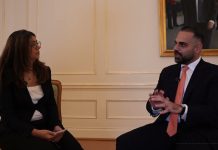
Speaking in an interview at the Swedish Parliament, Karapet said the scale of the Iranian regime’s crackdown on nationwide protests in January demanded a stronger response from Sweden and other democracies.
“We can close the embassy,” he said. “Second, we can close the Imam Ali Mosque, which the Swedish Security Service has pointed out as an internal threat to Sweden’s security.”
Swedish authorities said in 2025 that the Iranian regime had used the Imam Ali Islamic Center in Stockholm as a platform for espionage and activities targeting Sweden and members of the Iranian diaspora.
Karapet, who represents Stockholm and is affiliated with the nationalist Sweden Democrats, also urged Sweden to work through the European Union to tighten sanctions and confront the Islamic Republic’s attempts to use the Strait of Hormuz to exert pressure on the international community.
He accused the Iranian regime of carrying out a “massacre” during the Jan. 8-9 protests, and imposing an internet blackout to conceal the extent of the bloodshed. Karapet said more than 50,000 people had been killed, although the figure has not been independently verified. The Islamic Republic has acknowledged more than 3,000 deaths, while rights groups and medical sources have reported substantially higher tolls.
Karapet said, “The people of Iran need an alternative,” and described Crown Prince Reza Pahlavi as a central figure in the movement seeking to end the Islamic Republic.
Recalling a meeting with Pahlavi in Brussels after the 2022 Woman, Life, Freedom uprising, Karapet said he had told him: “Your Highness, you are the game changer.”
Karapet recalled that he and several parliamentary colleagues had invited the Prince to Sweden in 2023. Their plans were suspended while efforts were underway to secure the release of Swedish citizens held by Tehran. Sweden later freed Hamid Nouri, a former Iranian official serving a life sentence for war crimes and murder linked to Iran’s 1988 prison massacres, in exchange for Swedish citizens Johan Floderus and Saeed Azizi.
Mr. Pahlavi was subsequently invited to the Swedish Parliament in April 2026.
Karapet said supporting democratic change in Iran was also in Sweden’s national interest. The Swedish Security Service has accused the Iranian regime of using criminal networks in Sweden to target Israeli and Jewish interests.
“The Islamic regime of Iran is not only terrorizing its own citizens,” he said. “It also uses Swedish criminals to try to carry out acts of terror on our territory.” In 2024, the Swedish Security Services said that the Iranian regime uses criminal networks in Sweden “to carry out violent acts against other states, groups, or individuals in Sweden” that it regards as threats.
Karapet praised the Iranian community’s contribution to Swedish society and said some exiles might eventually return to help rebuild a democratic Iran. “I will always fight for a free, democratic Iran,” he said. “But helping the Iranian people inside Iran is more important, because they pay the highest price.”