By Kayhan Life Staff
Ali Khamenei burial ceremony in Mashhad began today, under the shadow of U.S. bombings, at the shrine of Imam Reza, the eighth Shiite imam. The shrine, in northeastern Iran, is one of the most important pilgrimage sites in Shiite Islam and the only burial place of a Shiite imam in Iran. Its significance extends beyond Iran to Shiite communities in Afghanistan, Pakistan, India and across the wider region.
For Khamenei, the choice of burial site was deeply symbolic. He had admitted at the time of his selection that he lacked the religious credentials required to be accepted as a marja-e taqlid, or source of emulation, in Shiite Islam. Yet burial at Imam Reza’s shrine offered a posthumous elevation of his religious standing — one that, at least superficially, placed him in a sacred setting even more prominent than that of Ayatollah Ruhollah Khomeini, the founder of the Islamic Republic. It also offered a practical advantage: a burial place shielded, by its religious importance, from possible U.S. or Israeli attack.
The funeral itself was elaborate, costly, symbolic and meticulously choreographed. It unfolded over six days, five cities and two countries. The procession moved from Tehran to Qom, then from Najaf to Karbala in Iraq, before ending in Mashhad.
The ceremony was meant to project power, reorganize the regime’s symbols and reaffirm the ideological foundations of the Islamic Republic. Instead, it exposed deep divisions within the country’s political and religious structures, as well as the regime’s growing isolation at home and abroad.
After nearly four months of uncertainty over the fate of Khamenei’s body, the funeral looked less like a demonstration of unity and authority than a public display of the former leader’s religious, political and international isolation.
The most striking absence was that of the senior Shiite clergy. None of the senior sources of emulation recognized by the regime’s own religious establishment performed the funeral prayer over Khamenei’s body. They were not even present at the ceremonies.
Grand Ayatollah Ali al-Sistani, the most revered Shiite cleric in Iraq and arguably the most influential Shiite authority in the world, was also absent and did not send a representative. In a short message, his eldest son said that Grand Ayatollah Sistani would be unable to lead prayers over the body of the martyred leader due to his physical limitations and health conditions. The message did not mention sending a representative. Indeed, his official representative in Iran was absent from the funeral procession and prayers held in Tehran.
That absence was significant. For decades, Khamenei had been presented not only as the political leader of the Islamic Republic but also as a religious authority and the “leader of the world’s Muslims.” Yet when the time came for his final religious rite, the senior clerical establishment kept its distance.
The political guest list inside Iran carried its own message. Mohammad-Ali Abtahi, an adviser to former President Mohammad Khatami, said several former senior officials of the Islamic Republic had not been invited, including Khatami and former President Hassan Rouhani. Former hard-line President Mahmoud Ahmadinejad, who governed from 2005 to 2013, was present.
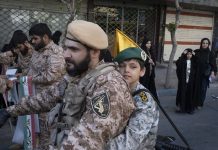
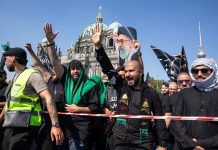
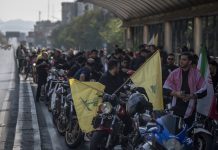
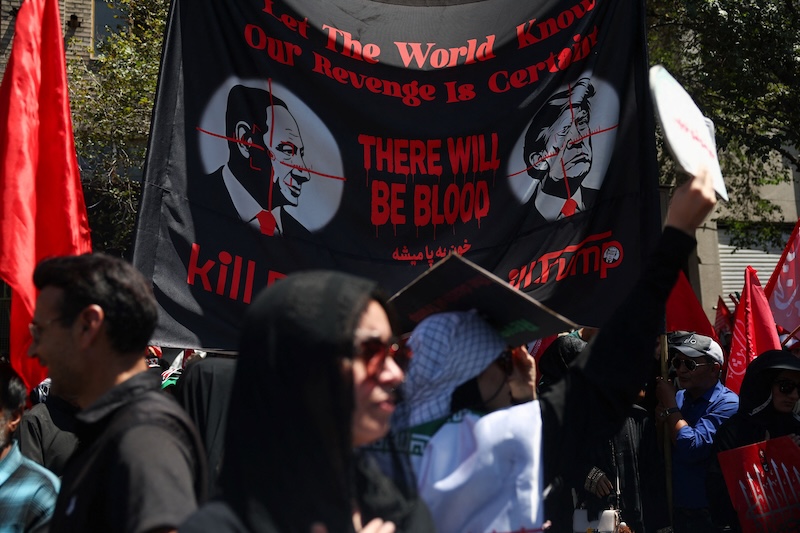
The contrast was telling. Former presidents associated with efforts to improve relations with the United States and the international community were excluded, while Ahmadinejad — remembered for his confrontational rhetoric toward the United States and Israel and his uncompromising posture on Iran’s nuclear program — was welcomed. Along the funeral route, mourners held up an effigy of Donald Trump and waved banners calling for his death.
Internationally, the ceremony also failed to restore the regional and global stature the Islamic Republic has long claimed for itself. No first-tier world leaders appeared to attend. European leaders were absent. So were senior leaders from Bahrain, Kuwait and the United Arab Emirates. Several governments sent second- or third-tier representatives rather than heads of state or foreign ministers.
For the funeral of a man whom the regime had portrayed as the leader of a regional power and a central figure in the Islamic world, this level of diplomatic representation conveyed a message beyond protocol. It reflected the cumulative costs of policies pursued under Khamenei’s rule — from political assassinations in Europe and bombings in the Middle East to the arming of proxy groups across the region and overseas operations stretching as far as the Horn of Africa.
Saudi Arabia, the Islamic Republic’s longtime regional rival, sent a deputy foreign minister. China, one of Tehran’s most important strategic partners, sent the vice chairman of the National People’s Congress. Their presence allowed the regime to claim international attendance. But the rank of representation told another story.
The ceremony was also marked by a carefully staged use of Quranic verses before foreign delegations — religious passages that appeared to signal how the regime viewed each guest. The most pointed message seemed directed at Saudi Arabia. Before the Saudi delegation, the regime recited a verse from Surah Al-Imran referring to “two armies that met in battle,” one “fighting in the cause of God” and the other “disbelieving.” The verse recalls the Battle of Badr, an early Islamic battle traditionally understood as a moment of divine vindication for the believers.
Khamenei was a dictator who saw himself as entrusted with establishing “God’s word on earth.” He had said that if war came, it would harm the United States. But war did come, and he became its first major casualty.
Now the remnants of the Islamic Republic are trying to turn his death into an image of power. Behind that image, however, stands a system that buried its leader belatedly; a system from which traditional clerics have distanced themselves; a system that excludes its own former insiders; a system whose funeral was largely avoided by world leaders; and a system whose black-clad men in the front row looked less like a symbol of unity than the opening act of a new phase of rivalry, distrust and power struggle.
Khamenei has a successor, but no replacement. What remains after him is not the charismatic center of velayat-e faqih — the doctrine of rule by an Islamic jurist — but an unstable collection of security, military, diplomatic and factional power blocs. To survive, they need both domestic repression and foreign bargaining.
In that sense, Khamenei’s noisy funeral was not the end of a crisis. It was the moment a long-brewing crisis became visible — a crisis feeding on the Islamic Republic’s own structural foundations and leading the system to implode.