By Kayhan Life Staff
A psychological thriller inspired by the events of January 8th and 9th in Iran — in which an estimated tens of thousands of protesters were massacred by the security forces of the Islamic Republic — is getting its premiere on Friday, July 10th at London’s Curzon Soho Cinema.
“77 Hours” — written and directed by the Iranian filmmaker and former television professional Vahid Mahdavi — is a survival thriller and political drama that takes place in Tehran during the nights of January 8 and 9, when Iran’s streets became the scene of one of the bloodiest crackdowns in recent history.
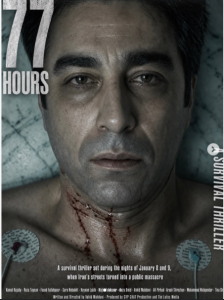 Exploring themes of survival, sacrifice, guilt, silence and the fragile line between truth and fear, the film follows ordinary citizens caught in the terrifying chaos of a public massacre. It aims to shed light on the violence and suffering that they experienced on the streets, in hospital corridors, and in hidden spaces. We see an injured man struggling to stay alive; a mother looking desperately for her missing child; and a doctor compelled to make impossible choices as he faces lethal threats from the state security forces.
Born in Isfahan in 1988, Mahdavi wrote and directed “Twenty Five Years Old Portrait” [sic] in 2021.
His new title, “77 Hours,” was produced in the United Kingdom by CVP CHAT Production and stars Kamal Rajaby, Reza Tayson, Fouad Fallahpour, Sara Nobakht, Keyvan Labib, Majid Falahpour, Reza Omid, Ali Pirhadi, Arash Shirozhan, Mohammad Nickpendar, and Tina Sh.
“77 Hours” uses a combination of real actors and AI-assisted cinematic reconstruction, digital scene generation and evidence-based visual references, and is being billed as one of the first ultra-realistic AI-hybrid political survival feature films.
Kayhan Life recently interviewed Mahdavi about his upcoming film.
The movie “77 hours” has been written, produced and directed in a very short space of time. When and how did the idea for this movie first come about?
The idea for “77 Hours” came very quickly after the events of January 2026. Like many Iranians, I was deeply affected by the reports, images, testimonies and fragmented accounts that were coming out despite the Internet blackout. What struck me most was not only the scale of the violence, but the silence around it internationally.
I felt that if these events were not visualized, they could easily disappear from public memory. As a filmmaker, I wanted to respond urgently, not years later. The speed of the production came from that sense of responsibility. The film was written, produced and directed in a very compressed period because I felt the story had to be told while the wound was still fresh.
“77 Hours” was born of a combination of eyewitness accounts, citizen journalism, visual research and dramatic reconstruction. It is not simply a political film; it is also about memory, fear, survival and the psychological cost of violence.
By releasing the film six months after the tragic events of January 2026, you are putting images to a massacre which – because of the Internet blackout in Iran – has been completely invisible to the rest of the world. This is the first feature film that visualizes those events. How important is it to tell the story of January 2026 for international audiences, and to contribute to a better global understanding of what happened?
It is extremely important. When the Internet is shut down, it is not only communication that is cut off; memory is also attacked. The world may not see the bodies, the fear, the streets, the hospitals, or the families searching for their loved ones. That invisibility protects the perpetrators and isolates the victims.
With “77 Hours,” I wanted to give form and image to something that many people outside Iran may not have fully understood. The film is grounded in real reports, eyewitness narratives and the atmosphere of those days, but it uses the language of cinema to make the experience emotionally and psychologically accessible to international audiences.
For me, this is not about propaganda. It is about human testimony. International audiences need to understand that behind every number, there is a family, a body, a voice, a person who had a life. Cinema can sometimes reach people in a way that news headlines cannot. My hope is that “77 Hours” helps preserve the memory of January 2026 and contributes to a wider understanding of what happened.
What would you like moviegoers to take away from the experience of watching “77 Hours”?
I want audiences to leave the cinema with the feeling that they have witnessed something that cannot be ignored. The film is intense, but its purpose is not shock for the sake of shock. It is about forcing us to look at what is often hidden.
I would like moviegoers to think about the cost of silence, the fragility of truth under dictatorship, and the courage of ordinary people who risk everything simply to be heard. The film is also about survival – not only physical survival, but the survival of memory.
If audiences leave with more empathy, more awareness, and a stronger sense that these stories must be documented and remembered, then the film has done its job.
The film is a psychological thriller, and the trailer contains graphic scenes with blood and violence. Can you speak about that?
The violence in “77 Hours” is not decorative. It is not there to entertain. It is there because the reality we are dealing with was violent. To make a clean, comfortable version of this story would have been dishonest.
At the same time, the film is not only graphic in a physical sense; much of its horror is psychological. It explores confusion, trauma, fear, memory loss, isolation, and the feeling of being trapped inside a system where human life has not protection.
The blood and violence are part of the visual language of the film, but the deeper focus is on what violence does to the mind and soul. I wanted the audience to feel the pressure, the uncertainty and the fear experienced by people caught in those events.
In what location was the film shot? And are the actors all Iranians living abroad?
The film was produced in the UK, with scenes designed and reconstructed to evoke Tehran and the atmosphere of the events. Because of the nature of the subject matter, it was of course impossible to shoot in Iran.
The cast is made up largely of Iranians living abroad, alongside performers and collaborators who understood the sensitivity and importance of the project. This was important to me because the emotional truth of the film depends on people who understand the language, the culture, the fear and the political reality behind the story.
Although the film was made outside Iran, its emotional and visual world belongs to Iran.
What has been the audience reaction to the film so far?
The film has not yet had a wide public release, but the early reactions from people who have seen parts of the film, the trailer, or private previews have been very strong and emotional. Many people have described it as disturbing, powerful and necessary.
For Iranians, the reaction is often very personal. Some viewers connect it immediately to memories, fears and images they already carry. For non-Iranian viewers, the response is different but equally important: many say it helps them understand the reality of what Iranians have been living through in a much more direct way.
The most meaningful reaction for me is when someone says: “This story needed to be told.” That is exactly why I made the film.