By Roya Kashefi
I must have been no more than 5 years old when football first entered my memory, not as a game, but as sound.
Amjadieh Stadium in Tehran was roaring. It was 1968, and Iran faced Israel in the Asian Cup final — a politically charged match between two countries that still maintained official ties before the 1979 Revolution. Near the end, Parviz Ghelichkhani, one of Iran’s most celebrated footballers, scored the decisive goal, sending the stadium, and the streets of Tehran, into a kind of collective delirium.
I do not remember every detail, but I remember the feeling. I remember the surge of bodies, the disbelief, the joy. Above all, I remember ‘Mamad Bughi’, his drum and the chant: “DuDuRu DuDuRu Du Iran!”
For a child, it was perhaps the first lesson in belonging. Not the official kind, not the flag-waving nationalism that governments manufacture, but something more instinctive: the discovery that joy can be shared by thousands of strangers at once.
Years later, in an English boarding school, that feeling returned in a very different setting. Iran was playing Scotland in the 1978 World Cup, and I had my O-level in physics the next day. We were allowed limited television privileges, but our housemistress made an exception. A handful of Iranian girls crouched in front of a tiny screen, willing the team to survive. In desperation, we placed a Qur’an on top of the television, directly above Iran’s goalkeeper, and moved it to the other side after half-time. None of us was particularly religious. But football makes theologians of us all when the ball is near our goal.
Then came 1998. By then, I was making a documentary for CNN, and my team was in Iran when Khodadad Azizi’s goal took Iran back to the World Cup. That moment was not only a sporting moment: it was existential. For the first time in years, Iran was returning to the world stage for something other than hostage-taking, sanctions, terrorism, clerics, and war.
We filmed the celebrations in the streets, the astonishment of players hearing women’s voices in Azadi Stadium, the disbelief that joy itself had briefly escaped state control.
And then Iran played the United States. For many of us in the diaspora, that match was not about defeating America. It was about being visible again, without shame. In London, Iranians who had spent years lowering their voices, hiding their identity, or explaining that they were not the regime, came into the streets wearing the three colors of Iran. The result mattered, of course. But what mattered more was that we were there.
And so now we arrive at another World Cup, another moment when Iran appears on the world stage. Once again, we are forced to ask questions no football supporter should have to ask. Should the players go? Should they be allowed to go? Should we cheer? Should we look away?
For supporters of other countries, football can be simple. It can be tribal, foolish, glorious, heartbreaking, and innocent. For Iranians, even joy is subject to interrogation. Even breathing is political. A goal is never just a goal. A flag is never just a flag. A team is never just 11 men on a pitch.
The Islamic Republic has tried to occupy every symbol of Iranian life: the language of sacrifice, the bodies of women, the grief of mothers, even the meaning of patriotism itself. It has tried to make love of Iran indistinguishable from loyalty to the state. That has been one of its most successful acts of theft.
But football taught me something before politics did. It taught me that belonging can exist without permission.
The roar in Amjadieh did not belong to a government. The little group of Iranian schoolgirls in front of a television in England did not need a state to tell them whom to love. The crowds in 1998 did not pour into the streets because the regime had made them proud. They came out because, for one brief, incandescent moment, Iran was visible beyond the prison of its rulers.
That is why the question is so painful now.
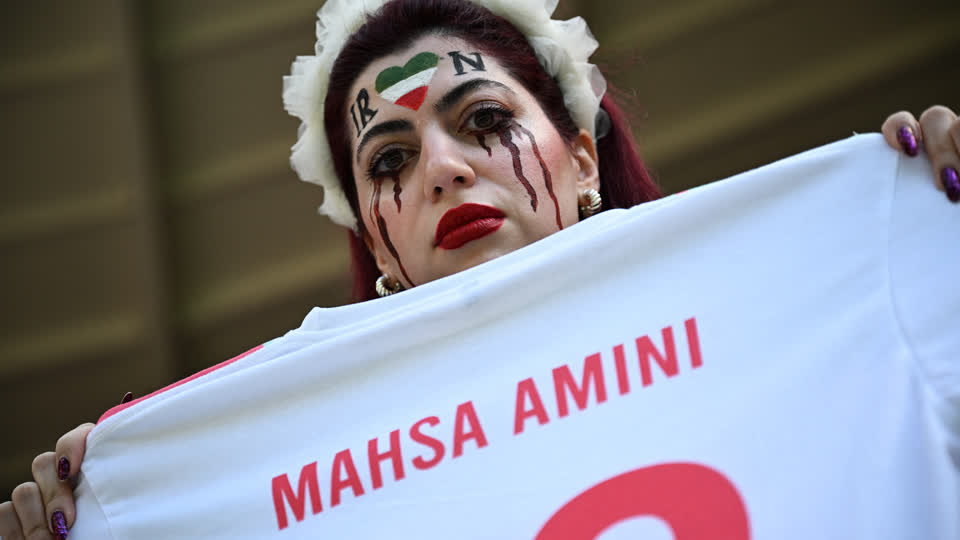
Because when the players appear silent while people are killed, when women are barred from stadiums, when girls suffer from the shame and fury of exclusion, when athletes are punished for gestures of solidarity, the national football shirt becomes heavier. It no longer carries only memory. It carries complicity, fear, coercion, calculation, and grief.
And yet I cannot surrender it completely.
I cannot give the Islamic Republic the last word on Iran. I cannot allow it to take even football from us without protest. I cannot pretend that a team selected under repression can freely represent a free people. Yet I can neither forget the child in Amjadieh, the schoolgirl before the tiny television, the woman filming the streets of Tehran in 1998, nor the exile who watched Iranians in London lift their heads and say, without apology, we are here.
Perhaps that is the only honest position left to us: not blind support, not empty boycott, but reclamation. To watch, if we watch, with our eyes open.
To cheer, if we cheer, not for the federation, not for the officials, not for the state that has stolen so much, but for the people whose lives are still tied to that name: Iran.
For the women who should have been in every stadium. For the girls who played without being seen. For Blue Girl. For the mothers who still wait.
For the young who risk everything for a future they may never enjoy.
For every Iranian who has been made to feel that pride itself is a betrayal.
Maybe one day there will be a team again that carries all of us. Not the state. Not a faction. Not a manufactured nationalism, afraid of difference. A team that can hold the hopes of every Iranian citizen, regardless of ethnicity, gender, or political creed.
Maybe one day a girl will walk into a football stadium without fear, without permission, without disguise, and shout herself hoarse for a team that knows she is part of its country.
Maybe one day football will be allowed to be football again.
Until then, I live with the contradiction. I grieve the theft. I rage at the silence. I mistrust the spectacle. But somewhere beneath all of it, stubborn and unreasonable as childhood itself, I still hear that roar. Not the regime’s Iran, but ours.
Roya Kashefi is the head of the Human Rights Committee at the Association des Chercheurs Iraniens (Association of Iranian Researchers) in Paris. https://aciiran.com/farsi/ The views expressed are her own.