By Kayhan Life Staff
Thousands of businesses in Iran are shutting down because of the Internet blackout imposed by the Islamic Republic since the Feb. 28 outbreak of the war with the U.S. and Israel. The shutdown, now in its 12th week, has cost the Iranian economy billions of dollars, and depriving tens of millions of citizens of access to the worldwide web.
Many of these businesses — which rely on social media and messaging apps to sell goods and services, process orders and advertise — have been compelled to set up sidewalk stalls and turn to street vending to survive.
While in recent weeks some people have reconnected with the outside world using VPN configurations and circumvention tools sold by companies linked to the regime, the exorbitant cost of these services has still left tens of millions of Iranians disconnected from the global internet.
The economic damage caused by the shutdown continues to escalate.
According to Tehran-based Asr-e Iran news, Afshin Kolahi, a member of Iran’s Chamber of Commerce, has estimated that direct losses from the internet blackout amount to $30–40 million per day, while indirect losses are estimated at $70–80 million per day.
Over the past 60 days, total economic damage has surpassed $4 billion.
One of the sectors most severely affected by the shutdown has been small businesses operating within Iran’s digital economy. Many of these businesses relied on social media platforms such as Instagram and messaging apps like Telegram for marketing, sales, and customer communication.
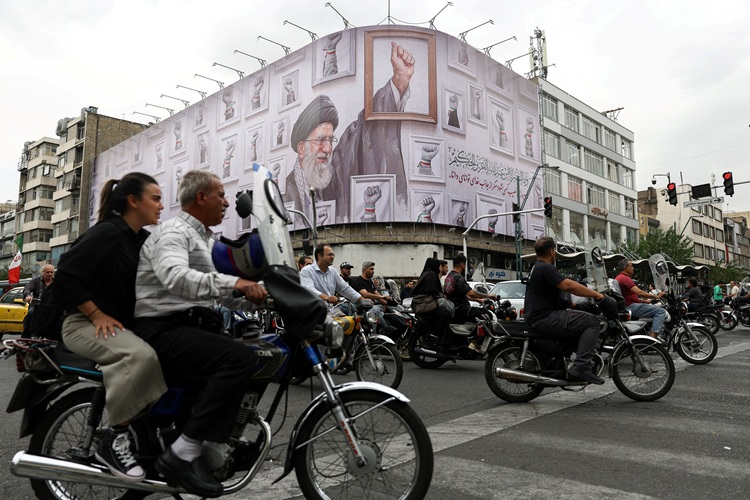
Reza Olfatnasab, head of Iran’s Union of Virtual Businesses, has warned of the mounting cost of the prolonged internet disruption, saying online sales in some sectors have dropped by as much as 70 percent.
He adds that around 2,000 companies have the capacity to survive for only another one or two months — a situation that, in his view, has pushed the country’s digital economy into a state of “structural instability.”
Some of these business owners, whose livelihoods depended entirely on their online operations, have in recent weeks resorted to selling their products on the streets.
According to the Islamic Republic News Agency (IRNA), more than two months of internet shutdowns have pushed many online businesses to the verge of collapse, fueling a noticeable increase in street vending as some merchants have effectively moved their operations from Instagram to the sidewalks of Tehran.
Economist Mohammad Reza Abdollahi had previously warned that the nationwide internet shutdown was driving a rise in precarious and low-quality employment. The macroeconomic analyst noted that following the internet restrictions imposed during the January protests, and again after the outbreak of the war in late February, many internet-based jobs disappeared and were replaced by unstable, low-quality work.
According to a recent IRNA report, if you walk from Keshavarz Boulevard in central Tehran toward Kargar Street — one of the city’s longest thoroughfares — and continue north around 8 p.m., you encounter a striking surge in street vendors.
Although such vendors were present before, the collapse of online sales and the municipality’s increased tolerance of sidewalk commerce have transformed many parts of Tehran into open-air marketplaces for people effectively forced to move their businesses from Instagram to the streets.
A former online shop owner, who once shipped products to cities across the country, was reduced to selling goods on the streets of his hometown, Amol, in the northern province of Mazandaran, during the nights leading up to the Iranian New Year, Nowruz (March 21).
Sharing a photo on X, they wrote: “During the holidays, I had to spend two nights street vending. It is not that the work itself is degrading — in fact, I have often said I wanted to experience it. However, being forced into it because of the internet shutdown was extremely difficult for me. It is extremely difficult.
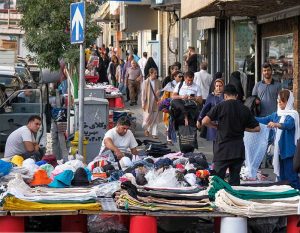
Not everyone who has recently turned to street vending, however, is a former online business owner. Many are among the growing number of people pushed out of work by the economic downturn that followed the internet shutdowns and the war, leaving them with little choice but to sell goods on the streets to earn a basic living.
One young man, for example, wrote that there was no longer any work available for him as a software programmer. He said he had put his computer up for sale so that he could begin street vending.
According to reports, the number of people who have lost their jobs since the war began has reached 4.5 million. This figure includes everyone from manual laborers and skilled workers to office employees, engineers, technical specialists, and even middle managers.
Rising living costs, combined with declining production and shrinking orders, have pushed businesses to cut expenses to survive, and laying off workers has become one of the first measures to reduce payroll costs.
One user on X described the situation this way: “I ate last night’s dinner as today’s breakfast. Detergent has become so expensive that I have to go to work in dirty clothes. I cannot afford deodorant. People all across the city have turned to street vending, and with the internet outages, it has become unbearable. If I do not get laid off today, on my way home, I will have to make 500,000 tomans (approximately $3.5) last until the end of the week so I can save money for medicine.”
Elham Morad, a community development facilitator and researcher, also wrote: “I feel that if I do not write about Tehran these days, I will be leaving something important unsaid. Lately, long walks through the city center — sometimes with Towhid, sometimes alone — have become part of our daily routine. We walk so much that by the time we return home, we collapse from exhaustion.”
“Perhaps this is one way of coping with the anxiety and uncertainty of these days. However, it is not only the act of walking that brings relief — it is seeing people, ordinary people in the broadest sense of the word. People whose thoughts you do not know, whose political views you do not know, whether they are happy or unhappy in that moment — you are simply witnessing their daily struggle to carry on living.”
The social activist added, “In recent days, especially at night, the number of street vendors across the city has increased dramatically. Along the routes we walk, nearly every sidewalk is lined with vendors. Many of them show clear signs that they have never done this kind of work before, and that their previous experience may have been limited to exhibitions or temporary markets with more structured conditions.”
She continued: “Most of these new street vendors appear to be producers themselves, or at least directly connected to producers. The goods sold across the city are often high quality, with many bearing recognizable names and brands. Our impression is that the streets of the city have become a physical extension of Instagram.”