By Kayhan Life Staff
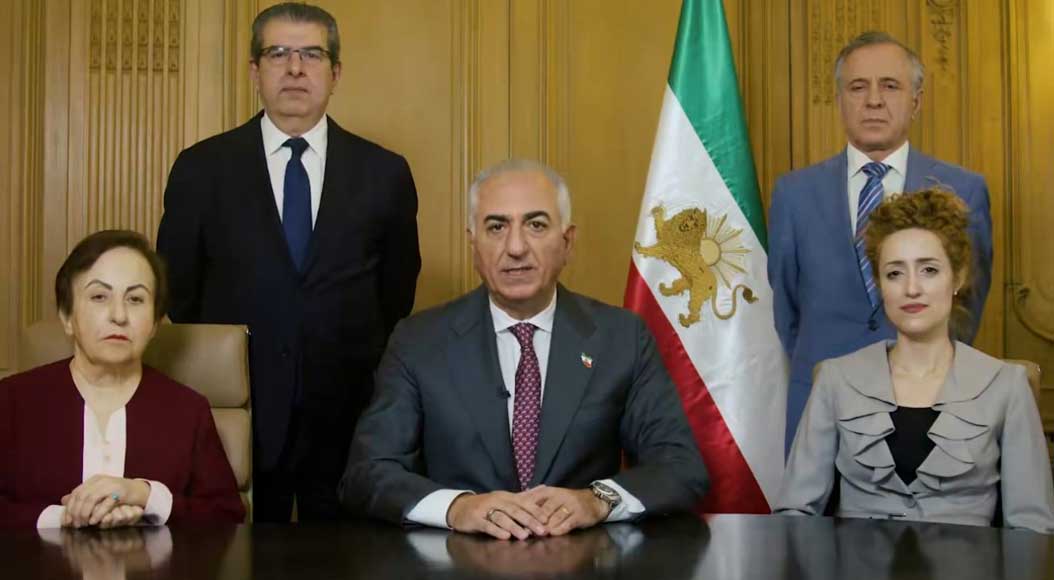
Reza Pahlavi, the exiled son of Iran’s last Shah and the country’s most recognizable opposition leader, is setting up a committee tasked with establishing a transitional justice system in a future Iran. Leading the committee is Nobel Peace Prize winner Shirin Ebadi, a former judge and human rights lawyer.
In a March 16 announcement, Pahlavi said the aim of the committee will be to set up a special future court that will prosecute those responsible for crimes against humanity under the Islamic Republic, as well as a truth commission to document decades of repression.
“Over the past five decades, victims of injustice, torture, and repression under the Islamic Republic have received no justice,” Pahlavi said, evoking “mothers and fathers, daughters and sons, sisters and brothers” who were still grieving and waiting for accountability.
Reza Pahlavi, like other opposition leaders planning the aftermath of authoritarian rule, is seeking to address an important challenge: how to tackle the legacy of decades of repression, imprisonment, torture, and death.
Post-authoritarian democracies such as South Africa and Argentina have set the example by setting up systems of transitional justice, whereby the crimes of the past are confronted through testimony, documentation, and sometimes prosecution.
The new body proposed by Reza Pahlavi, known as the Committee for Drafting the Framework for Transitional Justice in Iran, is part of the broader Iran Prosperity Project, his transitional plan for a lawful, structured transition from authoritarian rule to democratic government.
The March 16 announcement indicated that Pahlavi considers justice not a side issue to be handled after political change, but an important enabler of political change.
The committee’s four members, besides Ebadi, are Iraj Mesdaghi, the former political prisoner and writer; Leyla Bahmany, a legal adviser to the Iran Prosperity Project; and Afshin Ellian, an Iranian-born Dutch professor of law and philosopher.
Ebadi is the most internationally recognized member, and gives the committee a moral authority that extends beyond Pahlavi’s core supporters. Before the 1979 revolution, she was one of Iran’s first female judges and led a Tehran court.
After the Islamic Republic was established, women were banned from being judges and removed from the judiciary. Ebadi became a leading defender of Iranian dissidents, women, and children. In 2003, she became the first Iranian and the first Muslim woman to win the Nobel Peace Prize. Now in exile, she is widely respected and an influential figure worldwide.
In an interview with Kayhan Life, Ebadi said she saw accepting the role as both a professional and moral obligation.
“We study law for the day when it is needed,” she said. “And this is such a day: a moment when I believe I must do whatever is within my power to help enable a peaceful transition.”
She described the committee’s legal task as narrow but urgent: to prepare the rules governing the period between the collapse of the Islamic Republic and the establishment of a new constitutional order. With more than 50 years of experience as a judge and lawyer, and 11 books written on different fields of law, Ebadi said she believed she could make “a small contribution” to Iran.
Ebadi told Kayhan Life that the committee’s members had been drawn from different generations and different corners of the Iranian professional diaspora, and were united by their expertise in subjects relevant to a democratic transition.
She said the importance of the body lay in drafting a legal roadmap for implementing justice during the transitional period — the unstable interval after the fall of the current state and before a referendum, a new constitution, and a new parliament could be put in place.
In that interim period, she said, the constitutional and legal framework of the Islamic Republic will have lost its legitimacy, and many of its laws will have to be suspended. Punishments such as amputation, stoning, and execution, she said, cannot remain in force.
New rules would need to be readied in advance to prevent disorder and ensure continuity of government. “Otherwise, on the day the government falls, it will already be too late to gather a group of jurists around a table and begin writing laws,” she said.
The aim, she added, was to manage the transfer of power from the old state to the new one with the lowest possible human and economic cost — something she said would be impossible without a carefully prepared legal framework already in place.
Mesdaghi brings a different kind of legitimacy to the committee. Arrested in 1981 for his political activities, he spent roughly 10 years in Iranian prisons, including during the 1988 mass execution of political prisoners, one of the most traumatic episodes in the history of the Islamic Republic. After his release, he fled to Sweden, where he has written extensively about prison abuses, torture, and the 1988 killings, becoming one of the most prominent chroniclers of the period and a witness in international legal efforts tied to it.
Bahmany is a more technocratic figure. An Iranian legal expert and scholar of international law, she has studied law in Iran, the United States, and Canada. She has contributed to discussions and publications on the legal and political structures that emerge in times of emergency or democratic transition, including work on Iran’s post-regime planning and on frameworks for transitional governance and justice.
Ellian brings an academic dimension. An Iranian-born Dutch professor of jurisprudence at Leiden University, he has focused his career on international criminal law, social cohesion, multiculturalism, and citizenship. At Leiden, he heads the Department of Jurisprudence and holds leadership roles at the law school’s interdisciplinary institute.
Pahlavi’s office also said several prominent international jurists and experts would serve as advisers.
Supporters of the initiative said it was a serious step and not just a purely political gesture.
In a post on X, Ladan Boroumand of the Abdorrahman Boroumand Center for Human Rights in Iran praised the appointment of Ebadi and the inclusion of Mesdaghi. “We have worked with both Shirin Ebadi and Iraj Mesdaghi in seeking justice for victims of human rights abuses over the past two decades, and those collaborations have been both effective and deeply meaningful,” she said.
Boroumand said Ebadi had remained steadfast “both inside Iran and in exile” in defending victims’ rights and supporting those seeking accountability. “Iran’s political institutions are forged in the heart of transitional justice,” she wrote. “This is one of the most important stages in building a democratic system founded on the rule of law.”
The Boroumand Center, dedicated to documenting human rights abuses and promoting democracy in Iran, is named after Abdorrahman Boroumand, the Iranian lawyer and pro-democracy activist assassinated in Paris in 1991, who was killed by agents of the Islamic Republic.
Another note of support came from Nazanin Boniadi, the Iranian-born human rights activist, actress, and 2023 Sydney Peace Laureate. In a message welcoming the appointment, Boniadi said the fact that Nobel laureate Dr. Shirin Ebadi would officially chair Reza Pahlavi’s transitional justice committee was “an important step toward bridge-building in the opposition” and added: “May this path be successful.”
Her endorsement suggested that the committee may serve to build broader common ground across the opposition.
Len Khodorkovsky, a former deputy assistant secretary of state in the Trump administration, also supported the committee. He wrote that it offered “a glimpse of a free Iran built on justice and accountability.”