(The following story contains graphic details of injuries sustained by Iranian protesters who were victims of the deadly January crackdown led by the Islamic Republic.)
On the evening of Jan. 8, in Mashhad, northeastern Iran, a nurse was working the night shift in a hospital emergency room when she saw a demonstrator being brought in with horrific injuries.
“His stomach was open, and his intestines were sticking out,” the nurse told Kayhan Life. “Two people were holding his arms and legs and running towards the emergency room, and another young man, who I later found out was his brother, was holding his intestines so they wouldn’t spill out.”
Tragically, the protester would die within minutes of arrival at the hospital. The nurse (who spoke on condition of anonymity) described other “apocalyptic” scenes on Jan. 8 and 9. She said that under normal circumstances, and in peacetime, a nurse “might treat a gunshot victim only once.” But over the course of those two or three days, “we witnessed scenes more harrowing than what some might see on a battlefield.”
The armed crackdown on protesters that started in December 2025 ranks the Islamic Republic of Iran as one of the most repressive governments of the 21st century. On Jan. 8 and 9, tens of thousands of people in cities across the country were met with live gunfire from government forces.
While a nationwide internet shutdown made it impossible to obtain accurate figures on those killed, injured, arrested, or missing, reports indicate that between 16,000 and more than 40,000 citizens have been killed, tens of thousands have been injured, and tens of thousands more have been detained.
EXCLUSIVE: How Children Were Targeted During the January Crackdown in Iran
Through a series of reports, Kayhan Life has sought to document eyewitness accounts from participants in protests across various cities and regions, compiling them into a historical record of the Iranian people’s uprising against the Islamic Republic. For their safety, the sources’ names have been withheld.
The nurse in Mashhad said she and her colleagues at the hospital never imagined on Jan. 8 that “something this catastrophic could unfold.”
“They were bringing in the wounded one after another. As far as I could tell, almost all of them were carried in by ordinary people and their families. On the night of Jan. 8, most of the injuries were caused by shotgun pellets, but on Jan. 9, live ammunition was used extensively in the crackdown on Mashhad,” the nurse explained.
“Most of the victims were young. We had no prior preparation for such a large influx of casualties. Some had died on the way to the hospital, or perhaps when they were shot, but their families and bystanders still rushed them there.”
“We were overwhelmed by a flood of people. We brought beds from other wards into the emergency room. The corridors and hallways were packed with beds, yet there still weren’t enough,” the nurse explained.
“The injured and the dead lay side by side on the floor. Nearly half of the wounded required surgery. They needed X-rays. We lined up beds for the injured not only in the emergency department, but also in the radiology department and outside the operating rooms.”
“Several critically ill patients were taken straight to the special ward. There were far too few emergency staff to handle the number of casualties. Under the hospital’s coordination, nurses from other wards came to assist,” the nurse continued.
“Most of the wounded were bleeding heavily. The hospital’s blood supply was quickly depleted, and the Iranian Blood Transfusion Organization (IBTO) was unable to meet demand. This became one of our most serious challenges.”
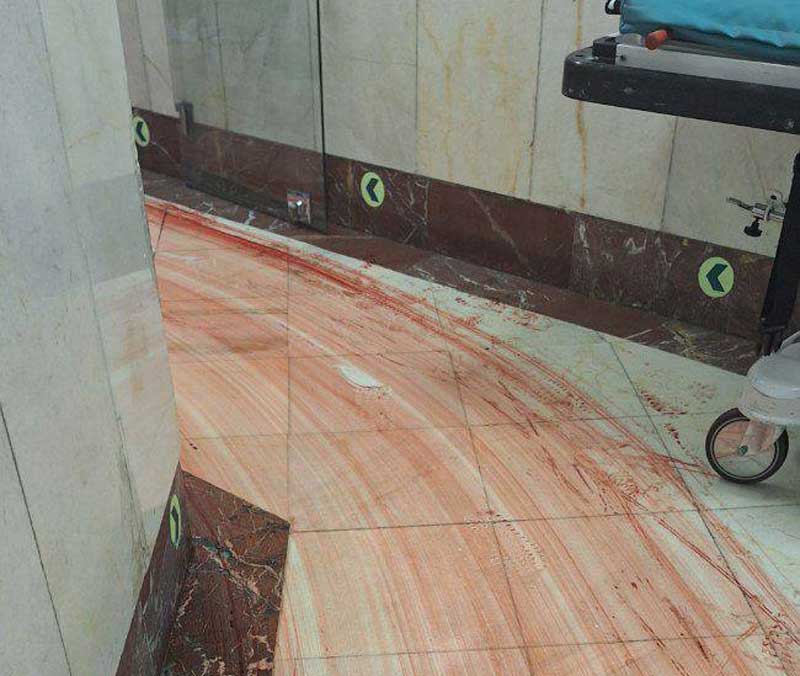
“Some families arrived after others had already brought in their children. The floors of the emergency room and corridors were covered in blood. Staff kept cleaning, but within minutes, the floors were red again. Some of the deceased were still bleeding,” the nurse explained.
“All of this unfolded in less than an hour, and we were confronted with a disaster of this magnitude in a matter of minutes, without any warning or preparation.”
“The hospital morgue was full, with no remaining space, and many of the bodies were left on the floors of the emergency room and the morgue, placed next to one another,” the nurse added.
“The cries of the wounded and the screams of relatives were indistinguishable, and our voices and those of other medical staff could barely be heard over the chaos.”
Describing the situation in the emergency room, the nurse said, “Less than an hour later, security forces flooded into the hospital. They were aggressive and spoke to both the public and the medical staff in a deeply insulting and degrading manner.”
“They shoved the beds of the wounded and even hurled insults at them. Several officers went to the supervisor and the head of the department, insisting they needed to speak with the hospital director.”
“After being informed of the number of wounded admitted, the hospital director left home and arrived within minutes. Security forces escorted the director and the administrator into a separate room. We later learned that they demanded a complete list of staff members, including those scheduled to work the following day,” the nurse explained.
“The security forces took control of the CCTV system and stationed their personnel throughout various sections of the hospital. Several officers moved through the crowd and among the medical staff, ordering people to hand over their mobile phones.”
“Amid the chaos, with some patients’ lives hanging by a thread, the security forces themselves appeared frantic. They ordered families, companions of the wounded, and even relatives of the deceased to leave the hospital. People argued with them. Some shouted curses,” the nurse continued.
“The officers were not in police uniforms but in plain clothes. They were armed and deliberately held their weapons in full view so both staff and civilians could see them. They took the patient lists.”
“I was not at the reception at the time. Still, I later heard they had gone there, seized all the registered information about the injured, and stationed their own personnel alongside our colleagues at the reception desk.”
Describing the condition of the wounded, the nurse said: “They brought in a father and his son, both suffering from gunshot wounds. The father, an elderly man, was in far worse condition, so we began treating him first.”
“Struggling to speak, his voice weak and strained, he kept pleading, ‘Do not worry about me. My son is finishing his master’s degree this year. He is young. He is in love. He has not had the chance to see the world yet. I have already lived my life—save my son. Please, leave me and help him.’”
The nurse said the staff was unable to determine whether the security personnel who arrived at the hospital in the first minutes were from the Ministry of Intelligence of the Islamic Republic of Iran or the Intelligence Organization of the Islamic Revolutionary Guard Corps (IRGC).
In the days that followed, however, colleagues reported that IRGC intelligence forces had been stationed at the hospital. According to the nurse, reports of their presence continued even a month later.
The night of Jan. 8 marked the beginning of harrowing days for medical staff across much of Iran. Within hours, hospitals in some cities were overwhelmed by hundreds of injured patients and fatalities.
At the same time, healthcare workers faced mounting pressure from security and judicial authorities. Many endured intimidation, insults, and humiliation simply for carrying out their professional duties and treating the wounded — a development that signaled a new chapter of repression in the Islamic Republic.
Human rights organizations report that security agencies have arrested dozens of doctors, nurses, and other medical personnel over the past month.
Kayhan Life understands that hundreds more remain under intense security pressure.
One such individual is a general practitioner working at a hospital in Tehran who has reportedly been threatened multiple times by the Ministry of Intelligence.
The doctor told Kayhan Life that on the night of Jan. 8, the emergency room was suddenly inundated within minutes by crowds carrying the injured and the dead — many believing their loved ones were still alive, or unwilling to accept that they had lost them.
This doctor, much like the nurse in Mashhad, expressed disbelief at the scale of the disaster. Even after more than 30 days, they still struggle to believe that the government could unleash such a barrage of lethal force against its own people.
With every breath, they can still smell blood, burned flesh, and gunpowder. Many of the doctors’ colleagues have reportedly resorted to taking antidepressants and anti-anxiety medication in the aftermath of those bloody days.
“We could hear gunfire coming from inside the hospital, and colleagues started whispering that people might be being shot. Some thought it was an active shooter situation. Others even said Israel had attacked and that the gunfire was defensive. But no one believed that civilians had been subjected to a barrage,” the doctor explained.
“When the crowd of wounded arrived, most of us were in shock. As we worked frantically to resuscitate patients and stop the bleeding, we kept hearing accounts from their companions, who were often even more shaken than we were.”
“Some were furious, recounting what had happened while cursing the government. Others were crying. And some were so deeply traumatized that they stared at the scenes of blood and death before them, eyes wide, lips dry and pressed tightly together,” the doctor concluded.
Security forces reportedly followed a coordinated and consistent protocol in taking control of hospitals across different cities.
Medical staff who spoke to Kayhan Life in Isfahan (central Iran) and Tehran described hospitals being swiftly occupied by large numbers of security personnel.
They said staff’s mobile phones were inspected or monitored to prevent them from photographing or filming the wounded and the dead, and that hospital CCTV footage was also seized or controlled.
Another doctor working at a Tehran hospital told Kayhan Life: “The medical staff saw shocking scenes; for example, a teenage boy whose eyes had been knocked out by the pressure of a bullet but was alive. Or a patient who had been shot in the head, a piece of the skull bone had come off, and brain tissue was visible, but the patient had a pulse and was alive. Another young boy had been shot in the back, and the bullet had come out the front, with serious damage to his kidneys and intestines.”
An emergency room doctor told Kayhan Life, “Security forces flooded the hospital. The emergency ward was so overcrowded with the wounded and the dead that it was difficult even to walk. At our hospital alone, between the night of Jan. 8 and 6 a.m. on Jan. 9 — roughly within those early morning hours — we received 200 bodies.”
The doctor added that security personnel entered the hospital wearing masks.
“They had already killed people and then came to intimidate medical staff, patients, and their families,” the doctor said. “They wore masks out of fear. They demanded a list of the injured and were trying to identify and interrogate them. Some of the wounded had only just regained consciousness moments before they died, making it impossible — and dangerous — for them to speak.”
According to the doctor, some injured individuals were brought in by the security forces themselves. Most of them had been struck with blunt objects rather than shot.
“They were registered under a fixed code beginning with the number 400. There were only a few of them. Later, we learned they were government agents who had been beaten and injured by members of the public,” the doctor explained.
“For several days, the hospital felt like a high-security zone. Even our colleagues were afraid to speak openly with one another, and we were under constant surveillance. I became particularly cautious because I was accused of deliberately refusing to prioritize the patients they brought in — people they considered their own,” the doctor said.
“An argument followed, and that confrontation became the beginning of a case that is still ongoing. I asked them a simple question: who should be treated first — someone with a minor injury, stable and not in danger, or a young man with severe brain trauma, slipping into a coma?”
“They took my phone for a few minutes and searched through it in a room nearby. I had wanted to document the horrific scenes we were witnessing, but in the chaos — where even a single minute could mean the difference between life and death — there was no time.”
“They found nothing on my phone. Still, a few days later, I was summoned and repeatedly threatened over the phone. To this day, I suspect my phone is tapped,” the doctor continued.
“The threats stemmed from what happened on the night of Jan. 8. Security personnel were evacuating the injured from the hospital. They claimed they were making arrests, but they were abducting them.”
“For days after the protests, vans were stationed outside the hospital from morning until night. They would check every discharged patient and, if they suspected someone had participated in the protests, they would take them away,” the doctor said.
Describing how the hospital staff protected the wounded from the security forces, the doctor said: “On the second night, we found ourselves in the position of having to protect patients from them. We discharged emergency patients through the back door, which led to the hospital’s backyard, to keep them out of sight.”
“Several young women who had been shot and undergone surgery were admitted to the maternity ward so we could say they were in labor or recovering from gynecological procedures.”
“We exchanged phone numbers with dozens of families and later treated their injured relatives at home. We removed bullets, repaired wounds, and stitched them up. The authorities seem to suspect us of these actions, but they have no evidence against me,” the doctor continued.
“Even if they were to produce evidence now and sentence me to death, I would remain at peace, knowing that I fulfilled my professional duty, honored my medical oath, and carried out what I believe was my responsibility to my country,” the doctor declared.
Another emergency doctor, who reported similarly disturbing observations, described to Kayhan Life the type of ammunition used in the crackdown: “We performed CT scans on the heads of those who had been shot. It was unusual — the entry wound was very small, but the scans showed that the entire interior of the skull had been shattered.”
“It was extremely strange, and I still do not understand why bullets of that kind were used.”
The doctor also described the chaos that unfolded on the night of Jan. 8, when internet and telephone services were cut off, severely disrupting medical care.
“We were at the clinic when we suddenly heard what sounded like a hailstorm. Then all phone lines went dead. Even doctors couldn’t contact their colleagues. For instance, if a patient had no pulse or we couldn’t determine why their heart rate was dangerously high, we needed to consult a specialist—but we couldn’t. We tried to reach surgeons to come to the hospital, but there was no way to call them.”
He further noted that security forces directly interfered with medical treatment.
“They prevented us from transferring patients. One patient urgently needed to be moved to a specialized ophthalmology hospital for an eye drainage procedure. Our intensive care ward was full, and we had arranged transfers for critically ill patients to other hospitals, but security forces blocked them,” the doctor explained.
“They stood outside the operating room and refused to allow blood supplies in. We wanted to collect blood from relatives and companions because supplies were critically low, but they would not permit it. They insulted patients and said they should die.”
“They also forbade us from recording patients’ names, surnames, or national ID numbers. Instead, they removed the injured individuals’ identities from their files and replaced them with code numbers. This meant that if a critically injured patient died, we would not even know who they were,” the doctor noted.
“In the days following the end of the protests, several members of the Basij (volunteer militia) were brought to our hospital. After being recognized by members of the public as having taken part in the crackdown, they were beaten and severely injured. There were also several fatalities among them. In smaller communities, where people tend to know one another, identifying them was easier.”
“On Jan. 11, some families decided to retrieve the bodies of their children from a hospital. According to reports, a sniper had been positioned on the hospital roof, with others stationed on nearby buildings,” the doctor said.
“It appears that the families’ plans were leaked to security forces. Witnesses say that when people arrived at the hospital at night, gunfire broke out, leaving several dead and wounded. Officers quickly removed the bodies of those killed in a truck, and their whereabouts remain unknown.”
“There were five patients declared brain-dead whose organs could have been donated for transplantation,” the doctor added. “However, security officers refused to allow it, reportedly calling them ‘rebels.’ The life-support machines were forcibly disconnected.”
The doctor also addressed the images showing deceased individuals in the morgue with catheters, breathing tubes, and other medical equipment still attached.
“We did not witness any gunshots fired at injured patients inside our hospital. While interference by officers that disrupts medical treatment could itself be considered a form of killing, I personally did not see any patient being shot. Like others, I have heard reports that such incidents may have occurred elsewhere, but I did not observe this firsthand,” the doctor noted.
“According to protocol, when a hospitalized patient dies — that is, after being formally admitted — all medical equipment is removed, and the body is handed over to forensic medicine,” the doctor explained.
“However, in certain emergencies, particularly when a death occurs in the emergency room under special circumstances requiring forensic investigation, the equipment may remain in place so that forensic specialists can examine it.”
“At our hospital, because many injured people arrived within a very short time, I witnessed a case where a deceased patient remained on the emergency room floor so that staff could immediately treat the next critical patient. The morgue was also at full capacity,” the doctor said.
“On Jan. 8 and 9, when many bodies accumulated at the hospital, security forces themselves transferred the bodies to the morgue — at least, that is what they said. Once the bodies were removed, we no longer had any information about what happened to them.”
“Many of those injured during the protests chose not to seek treatment at medical centers. However, it would be better for them — as well as for those who underwent surgery at home or in hospitals by dedicated and honorable medical staff — to visit trusted doctors or medical facilities for follow-up examinations to ensure their condition is stable and under control,” the doctor noted.
The doctor also warned that the wounded and survivors should remain vigilant about potential complications, particularly infections.
“Special attention is needed in cases involving shotgun pellets or bullets, as these can shift inside the body and potentially damage vital arteries or nerves,” the doctor warned.