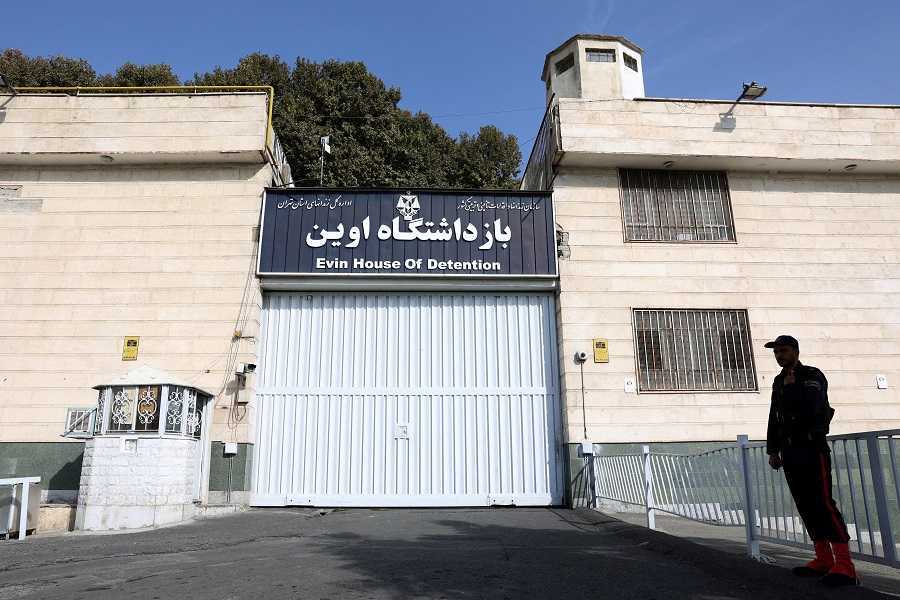
Members of the Islamic Republic’s Revolutionary Guard Corps (IRGC) and the Ministry of Intelligence opened fire on detainees in Evin prison following a strike by Israeli missiles which hit the jail, according to firsthand accounts published July 7 by the Oslo-based Iran Human Rights organization (IHRNGO).
Dr. Ahmadreza Jalali, a dual national sentenced to death on charges of spying for Israel was also removed from the prison and taken to an undisclosed location, Iran Human Rights reported.
The missile attack took place on June 23 during a 12-day war between Israel and the Islamic Republic — started on June 13 by Israel after the regime’s refusal to stop its nuclear program. That was the aim of negotiations to reinstate a 2015 nuclear deal between the regime and China, France, Germany, Russia, the United Kingdom, and the United States.
The Israeli operation targeted nuclear plants, IRGC facilities and a missile complex. Israel also said it struck the notorious Evin prison in Tehran in order to enable political prisoners to escape. Five prisoners were killed after several missiles struck the jail, according to the Islamic Republic’s semi-official ILNA news agency.
“Around 2 p.m., after recovering from the initial shock, IRGC and Intelligence Ministry agents turned their guns on prisoners who were helping the wounded, aiming at their chests and foreheads,” political prisoners Abolfazl Ghadyani and Mehdi Mahmoudian said in a letter published by IHRNGO. “Despite the risk of another Israeli strike, inmates from Ward 4 were forced back into their cells and locked in. Water was cut off, and parts of the ward were left without electricity.”
The doors of the prison’s high-security wing were hit, and opened as a result of the strike, according to the letter. Several prisoners and guards fled, leaving only a handful of officials to assist the injured. The letter described the injuries sustained by Dr. Makarem, an infectious disease specialist who the letter said volunteered once a week to care for the prisoners. The severity of her injuries led her to lose one arm and one leg.
Ghadyani and Mahmoudian added that dozens of conscripted soldiers who were mostly 18 to 20 years old were killed due to the destruction of the prison gate and barracks. Surviving prisoners were then asked to prepare to leave the jail.
“Gradually, the number of security forces around and behind Ward 4 increased. Around 5 p.m., in an aggressive language, prisoners were warned they had just 10 minutes or they would be shot,” Ghadyani and Mahmoudian went on. “No one knew the destination—prisoners were simply told to prepare to move. Eventually, prison officials arrived and instructed prisoners to leave with only a small bag.”
The letter described how the prisoners’ hands and feet were bound together while having to carry bags with their belongings on their shoulders as they were transported to an undisclosed location.
“Until around 8 p.m., prisoners were chained together in pairs by military and police forces. About 550 inmates, including over 50 suffering from serious conditions like cancer or in need of dialysis, were lined up with minimal belongings, shackled at the hands and feet,” the letter said. “A walk that would normally take five minutes on foot lasted two hours under the threat of weapons, in total darkness.”
Iran’s Judiciary Says Iranian-Swedish Djalali’s Execution Will Be Carried Out
Ghadyani and Mahmoudian also alleged that a fight broke out between the Islamic Republic’s intelligence forces and security officials while political prisoners were transferred to Tehran’s Greater Prison. The fight took place, the prisoners said, when intelligence officials tried to separate the prominent political detainee and dual national Dr. Ahmadreza Jalali from the other prisoners.
The altercation ended in a standoff between members of the intelligence forces and security guards, with Jalali remaining in the lineup until he reached Ward 2 of Greater Tehran Prison. Once in the prison, Jalali was removed and taken to an unknown location.
Jalali, a Swedish-Iranian emergency medicine doctor was sentenced to death in 2022 on charges of “acting against national security.” In that same year the Islamic Republic’s judiciary ruled out a prisoner swap for him.
The letter also described the prison conditions upon arrival, which Ghadyani and Mahmoudian said were cramped, dirty and very short on supplies.
“Small and large insects—including bedbugs, cockroaches, ants, and flies—along with severe humidity from evaporative coolers and extreme heat, deprived prisoners of sleep and peace. The water was foul and salty, tasting like swamp water,” the letter said. “The prison store had only a few items, and despite promises to provide basic supplies, prisoners were even denied the ability to buy blankets and pillows.”
The allegations in the letter raise serious concerns about human rights violations set out in international human rights legislation and humanitarian law. Several key abuses documented by IHRNGO and sourced from the letter include: failures to protect prisoners during war; the deliberate targeting of inmates by Islamic Republic officials; the denial of basic needs and medical assistance; and poor prison conditions at the new facility.